
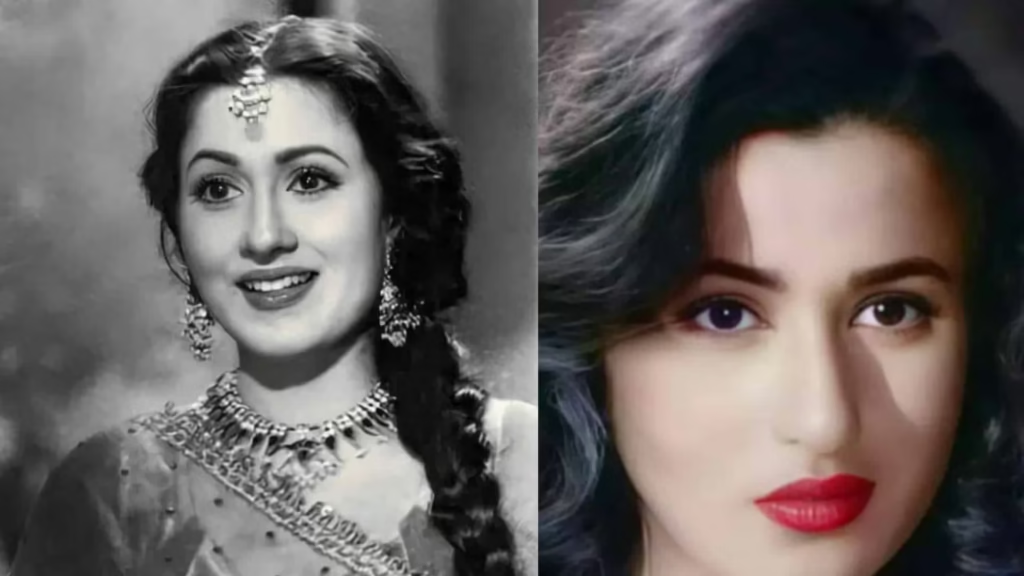
Table of Contents
“She was not just beautiful. She was the cinema itself.”
— Film critic Khalid Mohamed
| Field | Detail |
|---|---|
| Birth Name | Mumtaz Jehan Begum Dehlavi |
| Screen Name | Madhubala |
| Born | February 14, 1933, Delhi, British India |
| Died | February 23, 1969, Mumbai, India |
| Age at Death | 36 Years |
| Nationality | Indian |
| Religion | Islam |
| Profession | Actress, Film Producer |
| Active Years | 1942 – 1964 |
| Films | 70+ across romance, comedy, drama, and historical epics |
| Production House | Madhubala Private Ltd. (founded 1953) |
| Defining Role | Anarkali — Mughal-e-Azam (1960) |
| Known As | The Venus of Indian Cinema, The Marilyn Monroe of Bollywood |
| Filmfare | 1 nomination — Best Actress (Mughal-e-Azam, 1960) |
Madhubala was not simply a film star — she was a phenomenon that Indian cinema produced once and then spent the rest of its history trying to describe. Born into poverty in Delhi on Valentine’s Day 1933, she entered the film industry at eight years old, became one of the highest-paid actresses in India by her late teens, and left behind a legacy so enduring that 57 years after her death, she still wins online polls as the all-time favourite female star of Indian cinema. Her name became permanently synonymous with one role — Anarkali in Mughal-e-Azam — but to reduce her to that role alone would be to misunderstand both the woman and the career she built before it.
Early Life — Born Into Hardship, Made for the Screen
The Girl from Delhi
Mumtaz Jehan Begum was born on February 14, 1933, in Delhi, into a poor, conservative Pathan Muslim family. Her father, Ataullah Khan, worked as a peon at the Imperial Tobacco Company and struggled to provide for his large family of eleven children — five daughters and six sons. When the family’s home was destroyed in a gas cylinder explosion, financial desperation pushed Ataullah to look toward his most beautiful daughter as a possible breadwinner. Because Mumtaz had an almost otherworldly face from childhood — wide eyes, a smile that seemed lit from within, and a composure that made adults stop and look — her father saw in her features what the film industry would later see in her talent.
The Child Actor
Ataullah Khan took eight-year-old Mumtaz to meet actress Devika Rani, who ran Bombay Talkies, and Devika Rani was so struck by the child’s presence that she cast her immediately — and renamed her Madhubala, meaning “the honey-wine girl” or “the intoxicating beauty”. Her screen debut came in the 1942 film Basant, where she played a small role that nonetheless drew attention. Because her face registered emotion with unusual sensitivity even as a child, directors quickly recognised that Madhubala did not need to be taught how to perform — she simply was.
Family as Foundation and Burden
Her father Ataullah Khan managed her career for her entire professional life — a relationship that gave her financial stability and personal constraint in equal measure. Because her earnings supported the entire Dehlavi family from her childhood onward, Madhubala lived her professional life under the pressure of being not just an actress but an entire family’s survival. She accepted more work than her health could sustain, and the weight of that responsibility — financial and emotional — shaped both her professional choices and her personal unhappiness in ways that her audiences rarely saw from their seats in the cinema.
The Rise — Building a Career Before Mughal-e-Azam
The Nation-Wide Sensation (1949)
The film that made Madhubala a household name across India was Mahal (1949), directed by Kamal Amrohi. She played the ghost of a young woman in a haunted haveli, opposite Ashok Kumar, and the combination of her ethereal beauty with the film’s supernatural atmosphere created a screen presence that felt genuinely mythological. Her biographer Khatija Akbar wrote that the success of Mahal turned Madhubala into a “nation-wide sensation” virtually overnight. Because she was only sixteen when Mahal released, the speed of her ascent was staggering — and it created a market demand for her that would sustain one of the most prolific decades in Indian cinema.
The Highest-Paid Star of the 1950s
By 1951, filmmaker Aurbindo Mukhopadhyay reported that Madhubala charged ₹1.5 lakh per film — a figure that placed her at the very top of Bollywood’s pay hierarchy at a time when most leading men earned less. She appeared on Box Office India’s list of top actresses seven times between 1949 and 1961. In 1950, an American magazine featured her as “The Biggest Star in the World” — an international acknowledgment of her star power that arrived before satellite television, before social media, and before global entertainment had any infrastructure for recognising non-Hollywood talent. That recognition was earned purely through the magnetic force of her presence.
The Range Behind the Beauty
What is frequently underappreciated about Madhubala is that she built her reputation across completely different genres before Mughal-e-Azam arrived. Howrah Bridge (1958) showed her as a bold, modern woman in a crime thriller — a role that required physical confidence and street-level grit rather than classical femininity. Chalti Ka Naam Gaadi (1958) revealed an unexpected and delightful gift for slapstick comedy alongside Kishore Kumar, demonstrating playfulness and comic timing that most audiences associated with male actors rather than Bollywood’s most beautiful woman. Mr. and Mrs. ’55 (1955), directed by Guru Dutt, gave her a romantic-comedy role that sparkled with intelligence and wit. Because she proved herself across thriller, comedy, romance, and drama before Anarkali, the performance she delivered in Mughal-e-Azam in 1960 was not a lucky accident — it was the crystallisation of an actress who had spent fifteen years quietly mastering her craft.
Mughal-e-Azam — The Film That Made Her Immortal
The Making of a Masterpiece
Mughal-e-Azam is one of the most extraordinary productions in Indian cinema history, and the story of its making mirrors the grandeur of its subject matter. Director K. Asif began the project in 1944 with a different cast, but restarts, cast changes, and the sheer scale of his ambition meant that by the time the film was finally completed and released on August 5, 1960, it had taken sixteen years to make. Madhubala received ₹3 lakh for the role — an unprecedented sum for a decade-long commitment — and she earned every rupee of it through a production that demanded physical, emotional, and artistic reserves that few actors of any era have been called upon to supply simultaneously.
The Role — Anarkali
The character of Anarkali is one of the most beloved archetypes in the Mughal imagination — a court dancer of uncertain historical origin whose love for Prince Salim, son of Emperor Akbar, became a story that Persian poets, Urdu writers, and Indian playwrights had been retelling for centuries before K. Asif decided to commit it to celluloid. Madhubala’s Anarkali was a woman caught between love and empire — between the personal and the political — between the freedom of feeling and the fatal consequences of expressing it. What made her portrayal extraordinary was not the grandeur of the costumes or the scale of the sets around her, but the extraordinary economy of her performance within them.
What She Did on Screen
Film critic Dinesh Raheja described Mughal-e-Azam as the “crowning glory” of Madhubala’s career. Her contemporary actress Nimmi remarked after watching her performance: “With Mughal-e-Azam, Madhubala showed the world just what she could do. All the signs of a good artiste were there as far back as Basant, but Mughal-e-Azam was the final proof that she was an artiste par supreme”. A reviewer for The Indian Express wrote: “Scene after scene bears testimony to the outstanding gifts of Madhubala as a natural actress”. What those reviewers were responding to was something that no acting school can manufacture — a performer whose internal emotional truth was so precise and so present that every subtle movement of her eyes told the story without a single word.
Because Madhubala was already suffering from a serious heart condition during the filming of Mughal-e-Azam — a congenital ventricular septal defect that she had been living with for years — every physically demanding scene she filmed, every emotional peak she climbed, she did while her body was quietly failing her. The vulnerability that critics praised in her performance as Anarkali was not entirely manufactured — it was real, lived, and borrowed from a woman who understood better than anyone on set what it meant to love something you knew you could not keep.
The Song — Pyar Kiya To Darna Kya
The song Pyar Kiya To Darna Kya — “When You Have Loved, Why Fear?” — is among the most iconic sequences in the history of Indian cinema, and Madhubala’s performance within it is its permanent soul. In the scene, Anarkali stands before the full court of Akbar, defiant and dignified, publicly claiming her love for Salim at the cost of her own life. The song is an act of rebellion delivered as art — and Madhubala performed it draped in mirrors and candlelight, surrounded by the Mughal court’s disapproval, with an expression that held both love and terror simultaneously and let neither one win. Because that expression was real — because Madhubala knew exactly what it felt like to love someone at a cost — the sequence communicates something that acting technique alone cannot reach.
The Box Office Record
Released on August 5, 1960, Mughal-e-Azam broke every box office record in India at the time and became the highest-grossing Indian film ever made up to that point. Box Office India named Madhubala the most successful leading lady of 1960 as a direct result. The film’s second position on the year’s box office rankings — trailing only Mughal-e-Azam itself — was held by Barsaat Ki Raat, another film starring Madhubala, meaning she held both the first and second spots on India’s annual box office that year simultaneously. No other actress in Indian cinema history has matched that particular achievement.
The Mughal-e-Azam Effect — How the Film Changed Her Career Permanently
Mughal-e-Azam did not simply give Madhubala her best review — it rewrote the entire conversation about who she was. Before 1960, she was celebrated primarily as the most beautiful woman in Indian cinema. After 1960, she was recognised as one of its finest actresses — a distinction that matters enormously, because beauty fades with age while acting craft compounds with time. But because her health had deteriorated severely during the production, the very role that secured her artistic immortality was also the one that effectively ended her active career. A string of major offers followed the film’s release, but she had to refuse almost all of them. The crowning glory and the final performance arrived in the same package.
Personal Life — Love, Loss, and the Weight of Illness
Dilip Kumar
The most defining personal relationship of Madhubala’s life was her long, tumultuous romance with Dilip Kumar — the very actor who played Prince Salim opposite her Anarkali. They fell in love in the early 1950s and remained together for years in a relationship that the industry watched with alternating fascination and sadness. Their relationship eventually broke down over a legal dispute involving filmmaker B.R. Chopra’s film Naya Daur — when a court case compelled Madhubala to testify in a way that contradicted Dilip Kumar’s position, and the resulting rupture ended their relationship permanently.
Marriage to Kishore Kumar
In 1960 — the same year Mughal-e-Azam released — Madhubala married singer, actor, and comedian Kishore Kumar. Kishore Kumar was aware of her heart condition before the marriage and reportedly converted to Islam to fulfil a condition of the union. Because Madhubala’s health declined rapidly after their marriage, much of their time together was spent in hospital rooms rather than film sets. Kishore Kumar remained devoted to her care until her death in 1969. Their marriage was short and shadowed by illness, but Madhubala later said that Kishore Kumar’s warmth and humour were the kindest parts of her final years.
The Heart Condition
Madhubala had been living with a congenital heart defect — a hole in the heart — since birth. In the 1950s, treatment options for such a condition were limited even in the most advanced medical facilities in the world. She travelled to London for medical consultation and was told that surgery could help but carried enormous risk. She chose not to operate and returned to India to continue working. Because she kept her illness largely private throughout her career, audiences watching her most luminous performances had no idea that the woman on screen was slowly, irreversibly losing the physical battle her body was fighting offscreen.
The Legacy — India’s Eternal Screen Goddess
Madhubala died on February 23, 1969, in Mumbai, exactly nine days after her 36th birthday, after spending her final years largely bedridden. She was 36 years old — the same age as Marilyn Monroe when she died — and the parallel has not been lost on cultural commentators who note that both women became timeless icons partly because their deaths preserved them at the peak of their beauty, before time could rewrite the image.
Film analyst Khalid Mohamed called her “a one-of-a-kind phenomenon,” noting that “although over 50 years have elapsed since she passed away, Madhubala reigns as the poster queen of Bollywood”. Scholar Ashish Rajadhyaksha described her as “the greatest and most glamorous star of the 50s Hindi musical,” whose image was permanently preserved by her early death. In 2008, an Outlook online poll named her the “all-time favourite female star” in Indian film history — a remarkable result for an actress who had been dead for nearly four decades. In 2013, Eastern Eye ranked her 24th among the 100 Greatest Bollywood Stars ever. The Economic Times featured her in its list of 33 Women Who Made India Proud, and in 2008 the Government of India issued a commemorative postage stamp in her honour.
Because she never won a major award in her lifetime — her only Filmfare nomination was for Mughal-e-Azam, which she did not win — her posthumous recognition carries an additional poignancy. India’s greatest female screen talent of the 1950s and 1960s was never formally honoured by the industry she served. And yet she is remembered more vividly than those who were.
| Year | Film | Role | Notes |
|---|---|---|---|
| 1942 | Basant | Child Role | Screen debut at just 9 years old |
| 1947 | Neel Kamal | Lead | Established her as a leading actress |
| 1949 | Mahal | Ghost / Kamini | Nation-wide sensation and gothic cinema landmark |
| 1949 | Dulari | Lead | Major commercial success |
| 1951 | Tarana | Lead | By this stage she earned ₹1.5 lakh per film |
| 1952 | Saugand | Lead | Co-starred with Ashok Kumar |
| 1955 | Mr. and Mrs. ’55 | Lead | Guru Dutt’s classic romantic comedy |
| 1958 | Howrah Bridge | Lead | Bold noir-inspired crime thriller role |
| 1958 | Chalti Ka Naam Gaadi | Lead | Iconic comedy opposite Kishore Kumar |
| 1958 | Kala Pani | Lead | Strong performance in a crime drama |
| 1960 | Mughal-e-Azam | Anarkali | Career pinnacle — India’s highest-grossing film at release |
| 1960 | Barsaat Ki Raat | Lead | Second-highest grossing Indian film of the year |
| 1962 | Half Ticket | Lead | Final major commercial hit |
| 1964 | Sharabi | Lead | Final film appearance before retirement from cinema |
FAQ
Who was Madhubala?
Madhubala was a Hindi film actress, born Mumtaz Jehan Begum Dehlavi on February 14, 1933, in Delhi. She starred in 70+ films over two decades and is regarded as one of the greatest and most beautiful actresses in Indian cinema history.
What is Madhubala’s most famous film?
Mughal-e-Azam (1960), in which she played Anarkali — the court dancer who loved a Mughal prince — is her most celebrated film and is widely described as her greatest performance and the crowning glory of her career.
How did Mughal-e-Azam impact Madhubala’s career?
It secured her artistic immortality and box office dominance — making 1960 the year she simultaneously held India’s first and second-biggest box office positions — but her deteriorating health prevented her from accepting the flood of major offers that followed.
Why is Madhubala called the Venus of Indian Cinema?
The title reflects her status as the most celebrated beauty in the history of Indian cinema — a quality so consistently remarked upon by critics, contemporaries, and audiences across decades that it became her permanent designation.
How old was Madhubala when she died?
Madhubala died on February 23, 1969, at the age of 36, from her congenital heart condition — a ventricular septal defect she had lived with since birth.
Did Madhubala win any major awards?
She received only one Filmfare nomination — for Best Actress for Mughal-e-Azam — but never won a major industry award during her lifetime. Her recognition came entirely posthumously, including a 2008 commemorative stamp from the Government of India.
Who was Madhubala married to?
She married singer and actor Kishore Kumar in 1960, the same year Mughal-e-Azam released. He remained devoted to her care through her years of illness until her death in 1969.
