Table of Contents
Cristiano Ronaldo: Born Into Poverty, Built for Greatness
Cristiano Ronaldo dos Santos Aveiro (born February 5, 1985, Funchal, Madeira, Portugal) is the highest goalscorer in the recorded history of professional football — a man who, at 41 years of age, is still scoring at a rate of more than one goal per game, still captaining his national team, and still chasing a milestone (1,000 career goals) that no player in the modern era of the sport has ever reached. He has won five FIFA Ballon d’Or awards, five UEFA Champions League titles, one UEFA European Championship, one UEFA Nations League, and a domestic title in four different countries — England, Spain, Italy, and Portugal — a collection of honours so diverse it functions less like a trophy cabinet and more like a comprehensive argument against any single criteria for greatness. Now 968 goals into a career that began in 2002 at Sporting CP and continued through Manchester United, Real Madrid, Juventus, and currently Al-Nassr FC in Saudi Arabia, Ronaldo is living the final chapter of what football’s historians will almost certainly call the sport’s most statistically dominant individual career.
Early Life — Born Into Poverty, Built for Greatness
Funchal, Madeira, is a volcanic island off the Portuguese coast — beautiful, peripheral, and in the 1980s, deeply poor for families like the Aveivos. Ronaldo was the fourth and youngest child of Maria Dolores dos Santos Viveiros and José Dinis Aveiro, a municipal gardener who struggled with alcoholism throughout Cristiano’s childhood. The family lived in a small, overcrowded house, and Ronaldo has described sleeping with his siblings in shared rooms, his mother working multiple jobs to keep them fed. He was reportedly expelled from school at age 14 for throwing a chair at a teacher — an act of adolescent rage that actually accelerated his football career, since it led to him being enrolled full-time at the Sporting CP Academy in Lisbon. At 15, he was diagnosed with a racing heart condition requiring laser surgery — an event that could have ended his career before it started. He recovered and resumed training within weeks, a foreshadowing of the physical resilience that would become one of his defining professional characteristics across two decades of elite competition.
The Manchester United Years — Becoming a Superstar
Sir Alex Ferguson signed a 16-year-old Ronaldo for Manchester United in 2003 after United’s players were essentially dazzled by him during a pre-season friendly. The early years at Old Trafford were mixed — he had the skills but not yet the composure, and the English press was not always kind — but by 2007 and 2008, the transformation was complete. He won the Premier League three consecutive times (2007, 2008, 2009), the Champions League in 2008 scoring the opening goal in the Moscow final against Chelsea, and the inaugural Premier League Golden Boot in 2008 with 31 goals. The 2007–08 season — 42 goals across all competitions, Ballon d’Or, Champions League winner — remains one of the most complete individual seasons in football history, and it earned him his £80 million transfer to Real Madrid the following year.
Real Madrid — The Greatest Club Chapter in History
The nine years at Real Madrid (2009–2018) constitute a body of work that has no precise precedent in club football. In 438 appearances, Ronaldo scored 450 goals — a ratio that exceeds one goal per game across an entire nine-year stretch at the world’s most scrutinised football club. He became La Liga’s all-time leading scorer, breaking Telmo Zarra’s decades-old record. He won four Champions League titles, two La Liga titles, two Copas del Rey, and three consecutive Champions League trophies from 2016 to 2018 — something no club had achieved in the competition’s modern format. The 2013–14 Champions League campaign produced his record of 17 goals in a single edition — a record that stood unchallenged for over a decade and is only now being approached by Kylian Mbappé in the 2025–26 season.
| Milestone | Record | Year Achieved |
|---|---|---|
| Most international goals (men) | 143 goals in 225 caps | Ongoing |
| Champions League all-time top scorer | 140 goals | 2017, still held |
| Single-season CL record | 17 goals (2013–14) | Now under challenge by Mbappé |
| First player to 800 club goals | 800th goal | 2021 |
| First to score in 5 World Cups | Across 2006–2022 | 2022 |
| Most Ballon d’Or wins (joint) | 5 awards | 2008–2017 |
| All-time career goals (official competitive) | 968 and counting | April 2026 |
The Juventus and Return to United Years — Mixed Results
His move to Juventus in 2018 for €112 million was bold, controversial, and ultimately inconclusive. He won two Serie A titles and scored 101 goals in 134 appearances, but his primary stated ambition — delivering a Champions League title to Turin — never materialised, with Juventus being eliminated at the round of 16 by Porto in 2021 in a result widely considered one of the biggest Champions League upsets of the decade. His return to Manchester United in August 2021 was greeted with thunderous sentiment from the Old Trafford faithful, but the football reality of a United side in structural decline beneath the romantic reunion produced friction. His relationship with manager Erik ten Hag deteriorated publicly and irreparably, culminating in a bombshell November 2022 interview with Piers Morgan in which he criticised the club, its management, its facilities, and ten Hag by name — an act that effectively ended his time there and opened the door to Saudi Arabia.
Al-Nassr and the Saudi Chapter — Retirement Runway or Reinvention?
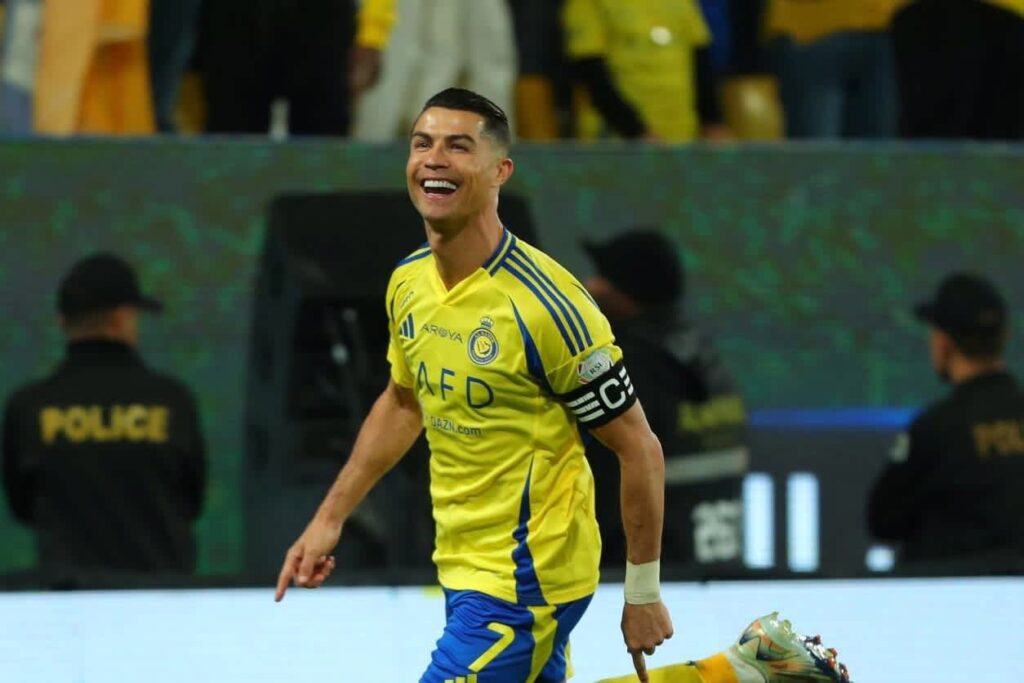
When Ronaldo signed for Al-Nassr FC in January 2023 on a reported salary of €200 million per year, the footballing establishment divided sharply: admirers argued he was extending his career on his own terms, critics argued it was a premature commercial decision that removed him from elite competition. What the critics did not anticipate was the sheer consistency of output. In the 2025–26 Saudi Pro League season, he has scored 24 goals in 24 appearances at a rate of 1.04 goals per 90 minutes — a number that would rank him among the top scorers in any league in the world. He has 5 goals in 5 Portugal World Cup qualifiers this season. His total 2025–26 cross-competition tally stands at 30 goals and 4 assists across 32 appearances. These are not retirement numbers. They are the numbers of a man who has refused, categorically, to negotiate with biological time.
The 1,000 Goal Quest — Football’s Last Great Individual Frontier
As of mid-April 2026, Ronaldo stands at 968 official competitive career goals — 32 goals from what would be the most extraordinary individual statistical milestone in the sport’s history. No player in the modern era has ever officially reached 1,000 competitive career goals, with the claims of Pelé and Romário including friendly matches and unofficial fixtures that are excluded from the current calculation. At his current rate of approximately 1 goal per game across all competitions, the 1,000-goal mark is projected to arrive in the early 2026–27 season if he maintains fitness. He has confirmed he will not retire before reaching the milestone, and he has confirmed the 2026 FIFA World Cup in North America — where he would be 41 years, 5 months old during the tournament — will be his final international competition.
Business Empire — Beyond Football
The CR7 brand is one of sport’s most commercially successful personal empires. Ronaldo is consistently ranked the world’s highest-earning athlete, with annual income exceeding $300 million when combining his Al-Nassr salary, endorsements, and business revenue. The CR7 brand covers fragrance, underwear, shoes, hotels (the Pestana CR7 hotel chain across Lisbon, Madrid, New York, and Funchal), a CR7 fashion line, and an app platform. His Instagram account, with over 650 million followers, is the most followed account in the history of the platform — a reach that makes him one of the most powerful social media advertising vehicles on earth. In early 2026, he invested approximately $7.5 million for a 10% stake in Herbalife’s AI-driven health platform, a strategic investment that positions his brand at the intersection of athletic performance and emerging wellness technology.
Personal Life — Family, Faith, and Georgina
Ronaldo’s personal life carries the specific complexity of a man who has had children through different circumstances. He has four children: Cristiano Jr. (born 2010, via surrogacy), twins Eva and Mateo (born 2017, via surrogacy), and Bella Esmeralda (born 2022) with his current partner Georgina Rodríguez, a Spanish-Argentine model and actress he met in 2016. A fifth child, a twin of Bella Esmeralda named Ángel, passed away at birth in April 2022 — a tragedy Ronaldo addressed publicly with a post that became one of the most shared and emotionally charged social media moments of that year. Georgina has her own Netflix docuseries, I Am Georgina, and the couple have been together for nearly a decade, though they have not formally married. Ronaldo is a devout Catholic and has spoken frequently about his faith as a source of psychological resilience through the pressures of elite competition.
The Controversies — The Cost of Being the Most Watched Man in Sport
Ronaldo’s public controversies are significant and have tested his reputation at several points. In 2018, he was accused of sexual assault by Kathryn Mayorga, a Las Vegas woman who alleged the incident occurred in 2009. Ronaldo denied the allegations, and the case — which Mayorga pursued through civil litigation — was dismissed in 2021 when a federal judge ruled that the accuser’s lawyers had obtained illegally leaked documents. The dismissal resolved the legal case but did not entirely close the court of public opinion. His tax fraud case in Spain resulted in a €18.8 million fine and a 23-month suspended prison sentence in 2019 — a conviction he accepted after confessing to deliberately defrauding Spanish tax authorities between 2011 and 2014. The Morgan interview that ended his second Manchester United stint drew criticism for its tone — specifically his claim that he felt “betrayed” by a club that had given him his first European platform — and was read by many as a self-serving act of reputation management that came at the club’s expense.
The Mbappé Record Challenge — An Uneasy Legacy Moment
In January 2026, Kylian Mbappé became the new Champions League record holder for goals in the group stage, surpassing Ronaldo’s 11-goal record from the 2015–16 season with Real Madrid. By April 2026, Mbappé had reached 14 goals in the current season’s campaign — three goals away from Ronaldo’s all-time single-season Champions League record of 17. The prospect of Mbappé breaking that record — at Ronaldo’s old club, in the competition Ronaldo dominated for a decade — is one of those narrative ironies that the sport occasionally produces with uncomfortable precision. Ronaldo himself plays in a competition (AFC Champions League Two) so far below the Champions League level that there is no meaningful competitive context in which to respond.
What Makes Him Irreplaceable — The Positive Case
The case for Ronaldo’s greatness does not rest on nostalgia. It rests on the arithmetic of what he has produced, at the standard he has maintained, across a career now entering its 24th year. At 41, he is scoring more than a goal per game in the Saudi Pro League. He is leading Portugal’s World Cup qualifying campaign with 5 goals in 5 games. He has 143 international goals — a record that the second-placed player (Ali Daei, 109 goals) is not anywhere near threatening. Beyond the numbers, there is the cultural dimension: he came from a volcanic island, from genuine poverty, from a family with no football connections, trained his body into a physical specimen that physiologists have studied as exceptional, and built — through obsessive discipline rather than natural talent alone — the most decorated individual football career in the sport’s history. That origin story is not separable from the statistics, and together they constitute a case that is difficult to dismiss regardless of where one sits in the Messi debate.
The Final Chapter — 2026 World Cup and 1,000 Goals
The remaining narrative arc of Cristiano Ronaldo’s career is now clearly defined: 32 more goals to reach 1,000, one more World Cup to complete the most storied international career in football history, and a final retirement that will almost certainly produce one of the largest media events in modern sport. The 2026 World Cup in North America — jointly hosted by the USA, Canada, and Mexico — will be a 48-team tournament, giving Portugal more games and Ronaldo more opportunities to contribute to the last collective chapter of a career that has always been equally about the team jersey as it has been about the individual record. Whether Portugal wins the trophy or not, the tournament will be the arena in which the sport formally says goodbye to its most statistically dominant player — a moment the game has been building toward since a teenage boy from Madeira first put on a Sporting CP kit in 2002 and started an argument about greatness that is still not fully resolved twenty-four years later.
Cristiano Ronaldo’s 968 Career Goals — Complete Breakdown by Club and Country
Here is the most precise available breakdown of Ronaldo’s 968 official competitive career goals, club by club and for Portugal, as of April 2026.
| Club / Team | Appearances | Goals | Era |
|---|---|---|---|
| Sporting CP | ~31 | ~5 | 2002–2003 |
| Manchester United | ~346 | ~145 | 2003–2009, 2021–2022 |
| Real Madrid | ~438 | ~450 | 2009–2018 |
| Juventus | ~134 | ~101 | 2018–2021 |
| Al-Nassr FC | ~130+ | ~125+ | 2023–present |
| Portugal (International) | 225 | 143 | 2003–present |
Real Madrid dominates his goal record by a wide margin — roughly 46% of his entire career tally came from his nine-year stint at the Bernabéu. His 450 goals there include 140 Champions League goals alone, which remain the all-time record in the competition. Manchester United contributed the early foundation — 118 league goals and a famous 31-goal Premier League season in 2007–08 that first announced him as the most dangerous forward in Europe.
His international record of 143 goals across 225 caps for Portugal is not just the men’s football world record — it sits 34 goals ahead of the second-placed active international scorer. Of these 143, he scored at five separate World Cups (2006, 2010, 2014, 2018, 2022) — a feat no male player in the tournament’s history has matched.
At Al-Nassr, the Saudi chapter that sceptics wrote off as a retirement lap, Ronaldo has been scoring at over a goal per game across all competitions. His 2025–26 tally alone is 30 goals in 32 appearances — a rate that projects him to reach 1,000 goals sometime in the early 2026–27 season.
The Machine Behind the Numbers — How Ronaldo Stays Elite at 41
The answer to how Ronaldo defies biological time is not one thing — it is a precisely engineered system of training, nutrition, recovery, and sleep that he has refined and tightened over two decades.
Training Structure — Intensity With Intelligence
Ronaldo trains three to four hours per day, five days a week, across sessions that combine cardiovascular conditioning, structured gym work, and football-specific drills. His cardio base is built through running, rowing, and treadmill work — exercises that sustain the aerobic engine required to cover 10+ kilometres per match without oxygen debt. This is layered with structured strength training: weights, isometric exercises, and functional movements designed not just to build muscle but to actively prevent injury. The football-specific phase includes sprint intervals across 30–50 metre bursts, change-of-direction cone work, agility ladders, and resistance band acceleration drills — all replicating the explosive, multidirectional demands of a forward. At home, his purpose-built private gym sees him performing leg extensions, hamstring curls, and cable resistance exercises targeting the hips, abductors, adductors, and glutes — the exact muscle groups that protect against the hamstring and groin injuries that age most fast forwards before their mid-thirties.
The Biological Age Paradox
In May 2025, fitness tracking company Whoop conducted a physiological assessment of Ronaldo that produced what may be the most astonishing single data point in elite sport: his biological age was measured at 28 years and 9 months. A man who is 41 by calendar operates internally as a 29-year-old athlete. His resting heart rate sits at 44 bpm — elite athlete territory — and his body fat percentage is 7%, against the 8–12% typical for professional footballers at peak age. He averages 17,000 steps per day, which includes time away from training — a baseline activity level that sustains metabolic efficiency even on rest days.
Nutrition — No Sugar, No Negotiation
Ronaldo’s diet follows a non-negotiable framework: six small meals per day rather than three large ones, prioritising lean protein, fresh fish (particularly swordfish, sea bass, and tuna), fruits, salads, and complex carbohydrates like wholegrain rice and vegetables. Sugar does not appear on his menu under any circumstances. He drinks water exclusively — no cold drinks, no alcohol, nothing that introduces empty calories or disrupts his metabolic baseline. The six-meal structure is a deliberate choice to maintain stable blood sugar and sustained energy levels across a full training day, preventing the energy troughs that large infrequent meals cause.
Recovery — The Sleep Science Behind Polyphasic Rest
Recovery is where Ronaldo perhaps deviates most dramatically from conventional athletic wisdom. Rather than sleeping in a single continuous block of seven or eight hours, he follows a polyphasic sleep method — five 90-minute sleep cycles distributed across a 24-hour period instead of one consolidated block. Each 90-minute cycle is timed to align with a complete sleep cycle (the approximate duration for one full NREM-REM rotation), meaning he wakes at the lightest stage of sleep each time, avoiding the grogginess and hormonal disruption of waking mid-cycle. He sleeps on a bespoke mattress developed specifically for his recovery needs, and supplements sleep with post-training cryotherapy — cold water or ice bath immersion — alongside sauna sessions that accelerate muscle repair through heat-induced circulation. He also practices Pilates regularly, which at his age functions as a maintenance system for core stability, posture, and muscular balance — precisely the physical qualities that erode fastest in aging athletes.
The Mental Architecture — Why Discipline Compounds
What separates Ronaldo’s longevity from other physically gifted athletes who faded earlier is the psychological infrastructure beneath the physical routine. He has spoken in multiple interviews about treating his body as a “temple” — not as metaphor but as operating principle. This means the same training intensity in the week before a match as in the week after one. It means no exceptions to the dietary rules during international breaks when team meals tempt deviation. It means sleeping correctly even when the social environment around him does not. Most elite athletes maintain discipline during peak competition years because external accountability — coaches, clubs, nutritionists — enforces it. What makes Ronaldo’s case rare is that the same discipline has been self-maintained into his 40s, at a club (Al-Nassr) that does not apply the monitoring intensity of Real Madrid or Juventus, in a league (Saudi Pro League) that does not carry the daily competitive pressure of Europe’s elite divisions. The routine does not require the pressure to sustain itself — it has been internalised so completely that it simply is who he is.