


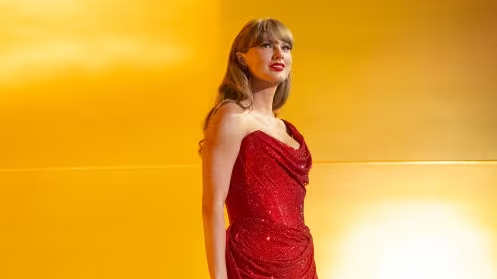
- Taylor Swift: The Global Pop Icon Redefining Modern Music
- Who Is Taylor Swift? (Quick Profile Box)
- Early Life and Family Background
- The Zero to Hero Story
- Career Beginnings — The First Step
- Breakthrough Moment — The Game Changer
- Discography — The Full Era-by-Era Map
- Biggest Hits and Blockbusters
- Awards and Achievements
- Net Worth 2026 — How Rich Is Taylor Swift?
- Personal Life — Love, Family, and Relationships
- Controversies and Challenges
- Upcoming Projects 2025–2026
- Why Taylor Swift Is an Inspiration
- FAQ — Taylor Swift Quick Answers
- How old is Taylor Swift in 2026?
- Where is Taylor Swift from?
- How tall is Taylor Swift?
- What is Taylor Swift's religion?
- What is Taylor Swift's net worth in 2026?
- What is Taylor Swift best known for?
- What was the Eras Tour?
- What is "The Life of a Showgirl"?
- Is Taylor Swift touring in 2026?
- Who is Taylor Swift currently dating?
- What are Taylor Swift's biggest controversies?
- How many Grammys has Taylor Swift won?
Taylor Swift: The Global Pop Icon Redefining Modern Music
There are pop stars, and then there is Taylor Swift — a category of one. She did not just write songs about her life; she built one of the most documented, debated and celebrated careers in modern music history, one album era at a time, until a girl from a Pennsylvania Christmas tree farm became the first musician to enter the billionaire class almost entirely through songwriting and live performance. No television show, no fashion brand, no family name — just a guitar, a notebook, and an almost obsessive need to turn every heartbreak, every betrayal, and every triumph into a song that millions of people felt was written about them.
By the time her record-breaking Eras Tour crossed two billion dollars in gross revenue and the world spent weeks debating her carbon footprint, her streaming dominance, and her NFL romance, it was clear that Taylor Swift had graduated from entertainer to cultural force. This guide covers everything — her early years on that farm in Pennsylvania, the Nashville grind that nearly broke her, the breakthrough that changed country music, the reinventions that kept surprising a skeptical industry, and the business moves that turned artistic ambition into a billion-dollar empire. Whether you are discovering her for the first time in India, following every release in the UK, or tracing her whole arc in Germany or the USA, this is the complete story.
Who Is Taylor Swift? (Quick Profile Box)
Taylor Alison Swift was born on December 13, 1989, in Reading, Pennsylvania, and today she stands as one of the most commercially successful and critically respected singer-songwriters of the 21st century. She is American by nationality, Christian by upbringing, and a one-woman industry by output — writing or co-writing nearly every song she has released across twelve studio albums spanning country, pop, indie-folk and alt-pop. Her estimated net worth in 2026 sits between roughly 1.6 and 2.1 billion dollars, placing her on Forbes’ celebrity billionaire list and separating her from almost every other musician alive. Primary profession: singer-songwriter, record producer, director, and touring juggernaut. Primary agency: CAA. Social media: @taylorswift13 across Instagram and X, with hundreds of millions of followers collectively.
Early Life and Family Background
Taylor grew up on an 11-acre Christmas tree farm in Wyomissing, Pennsylvania — a detail she later turned into a holiday song and a recurring symbol of the grounded, nostalgic identity she keeps returning to no matter how big the stages get. Her father, Scott Kingsley Swift, was a Merrill Lynch financial adviser, and her mother, Andrea Gardner Swift, was a former marketing executive who gave up her career to manage Taylor’s early ambitions, a decision that shaped the family-first, hands-on approach to Taylor’s business that has lasted for decades. She has a younger brother, Austin Swift, who later became a photographer and actor, and she has spoken warmly about the closeness of their sibling bond throughout her career.
From the age of nine, she was heavily involved in musical theatre, performing in local stage productions and traveling regularly to New York City for vocal coaching and acting lessons. Country music eventually pulled her attention harder than Broadway: after watching documentaries on Shania Twain and Faith Hill, she made a decision that country was her language and Nashville was her city. At eleven years old, she and her mother drove to Nashville and physically handed out demo CDs of karaoke covers to record labels along Music Row — and were turned away at every single door. Most kids would have gone home. Taylor went back to Pennsylvania, picked up a guitar, and decided that if no one wanted to sign a kid singing other people’s songs, she would write her own.
The Zero to Hero Story
Taylor’s “zero” is not poverty or hardship in the traditional sense — her family had resources and support. Her zero was invisibility in the one industry she needed to conquer, repeated rejection from labels who could not see past her age, and a music world that did not have a category for a twelve-year-old girl who wrote her own material and refused to perform anyone else’s. After the Nashville demo rejections, she linked up with a local musician who taught her guitar chords, started filling notebooks with original songs, and eventually got a publishing development deal with Sony/ATV Music Publishing — an almost unheard-of achievement for someone her age at the time.
Her parents then moved the entire family to Hendersonville, Tennessee, so Taylor could be physically closer to Music Row and attend the same schools as the children of industry professionals. She signed to Big Machine Records in 2005 under label head Scott Borchetta after leaving a development deal with RCA — a deal she walked away from because it would not let her release original music quickly enough. The “hero” part of the arc arrives in layers: first with a debut album that slowly builds a fanbase through genuine storytelling, then with “Fearless” turning her into the youngest Grammy Album of the Year winner in history, then with the re-recording battles that turned a contract injustice into a global conversation about who owns an artist’s life’s work. Every time the industry tried to box her in, she responded by releasing something that changed the conversation.
Career Beginnings — The First Step
Taylor’s professional entry point was the Nashville songwriter circuit, where she played writer rounds and writer showcases as a teenager, sitting in the same rooms as seasoned hitmakers and quietly studying how the business worked from the inside. Her first tangible commercial step was landing a publishing deal with Sony/ATV as a twelve-year-old, a move that gave her professional credibility before she had a single released, though it came with the expectation that she would be writing songs for other artists rather than leading her own career. She also appeared in Abercrombie & Fitch’s “Rising Stars” modelling campaign and contributed a song to a Maybelline compilation around this period, stacking small wins while waiting for a label deal that would let her be the artist, not just the supplier.
Her debut single “Tim McGraw,” written about her then-boyfriend leaving for college, released in June 2006 and cracked the top 40 of the Billboard Hot Country Songs chart. It was not an explosion; it was a slow, steady signal that there was a real audience for what she was doing. Her self-titled debut album followed in October 2006, and she spent the next two years playing support slots and smaller venues, building a fanbase one city at a time through relentless live performance and an unusually direct relationship with fans online during a period when most major artists were still ignoring social media.
Breakthrough Moment — The Game Changer
The moment everything changed was the release of “Fearless” in November 2008. The album crossed country into pop radio without sounding like it was chasing pop radio — “Love Story” rewrote Romeo and Juliet as a teenage fairytale and “You Belong with Me” made the nerdy girl with the guitar the hero of her own high school movie. Both songs became global hits, not just American country crossovers, and the album sold over ten million copies worldwide on its way to becoming the best-selling album in the USA in both 2008 and 2009.
At the 2010 Grammy Awards, Taylor won Album of the Year for “Fearless,” becoming the youngest artist ever to receive that honour at the time. The same ceremony also produced one of the most discussed moments of her career when Kanye West interrupted her VMA acceptance speech the previous year — an incident that, rather than derailing her, seemed to galvanise a fanbase that felt fiercely protective of someone they had watched grow up. From “Fearless” forward, the question was never again whether Taylor Swift belonged in the conversation. The only question was which direction she would go next.
Discography — The Full Era-by-Era Map
Taylor Swift’s body of work is best understood not as a list of albums but as a sequence of identity chapters, each one sounding like a different version of the same person at a different age and in a different emotional state.
Her self-titled debut (2006) is pure Nashville country-girl diary — first love, high school hallways, chasing stars. “Fearless” (2008) opens the fairytale chapter, blending country storytelling with massive pop melodies and producing her first international breakout singles. “Speak Now” (2010) is significant because every single song was written by Taylor alone, with no co-writers, a statement of artistic independence that silenced the “can she really do this without help?” critics.
“Red” (2012) is where things get genuinely interesting: she starts dismantling the country box, experiments with pop-rock and electronic production, and writes what many fans still call her most emotionally raw material. “1989” (2014) completes the genre switch to pure mainstream pop, aligns her with producers like Max Martin and Shellback, and produces the decade-defining banger “Shake It Off” alongside the darker, sharper “Blank Space.” “Reputation” (2017) is her public shutdown — darker production, less interviews, a refusal to play the media game, and songs about surveillance, identity, and the toxicity of being a public character rather than a human being.
“Lover” (2019) turns the page with bright, hopeful, rainbow-drenched pop, while “Folklore” and “Evermore” (both 2020), released during COVID-19 lockdowns with producer Aaron Dessner and Justin Vernon (Bon Iver), shocked the industry with indie-folk intimacy that won widespread critical praise from people who had previously dismissed her. “Midnights” (2022) is a 3am concept album, nocturnal and self-reflective, which broke Spotify streaming records on release day. Running parallel to all of this are her “Taylor’s Version” re-recordings — “Fearless,” “Red,” “Speak Now,” “1989,” and more — which came with previously unreleased “vault tracks” and gave fans two separate reasons to re-consume her entire back catalog. And next on the horizon: “The Life of a Showgirl,” her twelfth studio album.
Biggest Hits and Blockbusters
If you had to pick a single greatest hit, most analysts and fans would circle “Shake It Off” (2014) and “Anti-Hero” (2022) as the two defining commercial peaks — but her catalog runs so deep that “Love Story,” “You Belong with Me,” “Bad Blood,” “Blank Space,” “Cardigan,” “Look What You Made Me Do,” “Cruel Summer” and “All Too Well (Ten Minute Version)” all qualify as multi-generational touchpoints. “All Too Well (Ten Minute Version)” from Red (Taylor’s Version) in particular became a cultural phenomenon in late 2021, charting globally as a ten-minute song and proving that her audience would follow her anywhere.
On the live side, the Eras Tour is her supreme blockbuster. Spanning 149+ sold-out shows from March 2023 into late 2024, it grossed over roughly two billion dollars in ticket sales alone, shattering every previous record for tour revenue and reportedly generating economic impact in the billions across host cities. The accompanying concert film expanded the experience into cinemas worldwide and later hit streaming platforms, adding another revenue stream to an already staggering run.
Awards and Achievements
Taylor Swift holds a Grammy record that puts her in a class by herself: she is the only artist to have won Album of the Year four times, across “Fearless,” “1989,” “Folklore,” and “Midnights.” Beyond Grammys, she has won Billboard’s Woman of the Year, been named the American Music Awards’ Artist of the Decade, collected more MTV VMAs than she can comfortably carry, and received honorary doctorates from institutions including NYU. She is the highest-certified female artist in US history by the RIAA, the most-streamed female artist in Spotify history, and one of only a handful of artists to have every album certified multi-platinum. In 2026, Forbes placed her on their Celebrity Billionaires list, making her the first self-made music-only billionaire in the modern era.
Net Worth 2026 — How Rich Is Taylor Swift?
Taylor Swift’s 2026 net worth is estimated between approximately 1.6 billion and 2.1 billion dollars depending on the methodology — Forbes uses a more conservative catalog-valuation model while Bloomberg and entertainment finance publications push the figure higher when accounting for future royalties and ongoing deal flow. What makes her wealth unusual is where it comes from: not fashion lines, not TV deals, not a tequila brand or beauty venture, but music catalog ownership and live performance revenue.
Her income pillars break down roughly as follows: owned master recordings and re-recorded catalog generate publishing royalties, sync fees and streaming income continuously; the Eras Tour’s reported two-billion-dollar gross translated into direct touring profit after production costs; merchandise at record-breaking volumes per show added hundreds of millions; endorsements with brands like Capital One and Diet Coke and AT&T provide supplemental income; and a substantial real estate portfolio of properties across Nashville, New York, Los Angeles, Rhode Island and elsewhere adds asset value. The practical takeaway for your blog: present this as an estimated range, explain the sources, and note that her net worth is unusually clean in origin — it is almost entirely the product of recorded music and concerts rather than side business diversification.
Personal Life — Love, Family, and Relationships
Taylor’s personal life has been one of the most publicly analysed aspects of her career, partly because she has always drawn from it for songwriting, and partly because the media has spent years trying to decode which ex each album is “about.” Her family has remained the steadiest anchor: parents Andrea and Scott travelled with her extensively, appear in documentaries, and have been part of the emotional core of her public story from the beginning. Her mother Andrea’s publicly discussed cancer diagnosis added an emotional layer to the “Reputation” and later eras, with Taylor speaking about the fear and precariousness it created.
On the relationship side, her most high-profile public romance of the 2020s has been with Kansas City Chiefs tight end Travis Kelce, whose games she attended regularly during the 2023 NFL season and beyond, merging the worlds of pop music and American football in a media crossover that generated an estimated hundreds of millions of dollars in additional exposure for both parties. She has spoken more openly in recent years about anxiety, the pressures of public scrutiny and the importance of boundaries between her art and her private life — framing what she shares through music as intentional and what she protects in person as equally intentional.
Controversies and Challenges
Taylor Swift’s career has never been controversy-free, and handling these sections honestly is exactly what separates a quality bio from a hagiography.
The most famous incident is the 2009 MTV VMAs moment when Kanye West took the microphone from her during her acceptance speech, dismissing her win in favour of Beyoncé. It was globally televised, widely condemned, and set off a decade-long cycle of public conflict and reconciliation between the two camps. Years later, the leaked phone call between Taylor and Kanye — staged as proof she had approved “Famous” lyrics referring to her — became its own controversy when fuller recordings suggested the call was selectively edited. The episode and its aftermath are documented in “Reputation” and she has declined to revisit it at length since.
The master recordings dispute is the second major chapter: when Scott Borchetta sold Big Machine Records and her first six albums’ masters to Ithaca Holdings (tied to Scooter Braun) in 2019 without giving her what she described as a fair opportunity to acquire them, she went public with the conflict and announced the re-recordings. Critics of Scooter Braun rallied around her and the story became an industry-wide conversation about the ownership gap between artists and labels. Her private jet usage became a fresh controversy when a researcher tracked flight data and reported on its environmental footprint. She has not commented extensively on the jet criticism but the story remains in circulation, particularly in markets with high environmental awareness.
Upcoming Projects 2025–2026
Taylor’s next major project is “The Life of a Showgirl,” her twelfth studio album, announced for a October 2025 release. The album title positions the new era as a meditation on performance itself — the glamour, the loneliness, the spectacle and the emotional cost of being the show after years of living inside the Eras Tour. Reports suggest collaborators include familiar names like Max Martin and Shellback alongside newer creative partners, and there are rumours of at least one major duet, though nothing has been officially confirmed beyond the album and its release window.
As of April 2026, no new world tour has been officially announced, which is significant given the scale and length of the Eras Tour and Taylor’s own comments about needing rest. Industry speculation points to a future tour, residency, or unconventional live concept tied to the new album, likely in 2026 or 2027, but until an official announcement arrives it remains speculation. For your QuestQuip post, keep this section updated as facts arrive, and for now frame it cleanly as “what is confirmed” versus “what fans and insiders are anticipating.”
Why Taylor Swift Is an Inspiration
Taylor Swift’s story resonates the way it does because it is not about being chosen — it is about refusing to accept when you are not. She was rejected by every label she visited as a child, walked away from a major development deal because it came with creative restrictions she would not accept, and then fought publicly and commercially for ownership of her own artistic history when the industry tried to sell it without her consent. Every step of that story contains a choice that most people in her position would not have made — because the safe, comfortable, profitable route was always available and she kept picking the harder, more principled one instead.
For fans who grew up with her catalog, she also models something rare: the willingness to keep changing without pretending the old versions of yourself were wrong. She does not disown country Taylor or pop Taylor or folk Taylor; she archives them carefully, gives them updated “Taylor’s Version” releases, and moves forward carrying all of it. That blend of artistic integrity, business acumen, and emotional honesty across a twenty-year career is what makes her the rare celebrity whose story works as a genuine life lesson rather than just a marketing narrative.
FAQ — Taylor Swift Quick Answers
How old is Taylor Swift in 2026?
Taylor Swift was born on December 13, 1989, making her 36 years old in 2026.
Where is Taylor Swift from?
She was born in Reading, Pennsylvania, grew up in Wyomissing, PA, and relocated to Hendersonville, Tennessee as a teenager to pursue music in Nashville.
How tall is Taylor Swift?
Most profiles list her at approximately 5 ft 10 in (roughly 1.78 m).
What is Taylor Swift’s religion?
She was raised in a Christian household and has spoken about faith and prayer, though she does not position religion as a prominent public part of her identity.
What is Taylor Swift’s net worth in 2026?
Estimates place her 2026 net worth in the range of roughly 1.6 to 2.1 billion dollars, making her the first self-made music billionaire in the modern era.
What is Taylor Swift best known for?
She is best known for her deeply personal songwriting across multiple genre eras, record-breaking touring including the Eras Tour, and her high-profile campaign to re-record and reclaim her early music catalog.
What was the Eras Tour?
The Eras Tour was a 149+ show global stadium tour from 2023 to 2024 covering her entire discography, grossing roughly over two billion dollars in ticket revenue — the highest-grossing concert tour in history.
What is “The Life of a Showgirl”?
It is the title of her twelfth studio album, announced for October 2025, expected to reflect on performance, spectacle and life after the marathon of the Eras Tour.
Is Taylor Swift touring in 2026?
No tour for 2026 has been officially confirmed as of April 2026, though industry speculation continues about a future tour or residency concept linked to the new album.
Who is Taylor Swift currently dating?
She has been widely reported as in a relationship with NFL player Travis Kelce, a pairing that attracted enormous media coverage across pop culture and sports media from 2023 onward.
What are Taylor Swift’s biggest controversies?
The key controversies include the Kanye West 2009 VMAs interruption and its aftermath, the dispute over the sale of her master recordings to Scooter Braun, criticism over private jet carbon emissions, and debates about her chart dominance overshadowing other artists.
How many Grammys has Taylor Swift won?
She has won multiple Grammy Awards including four Album of the Year trophies — the most in history — across “Fearless,” “1989,” “Folklore,” and “Midnights.”

