


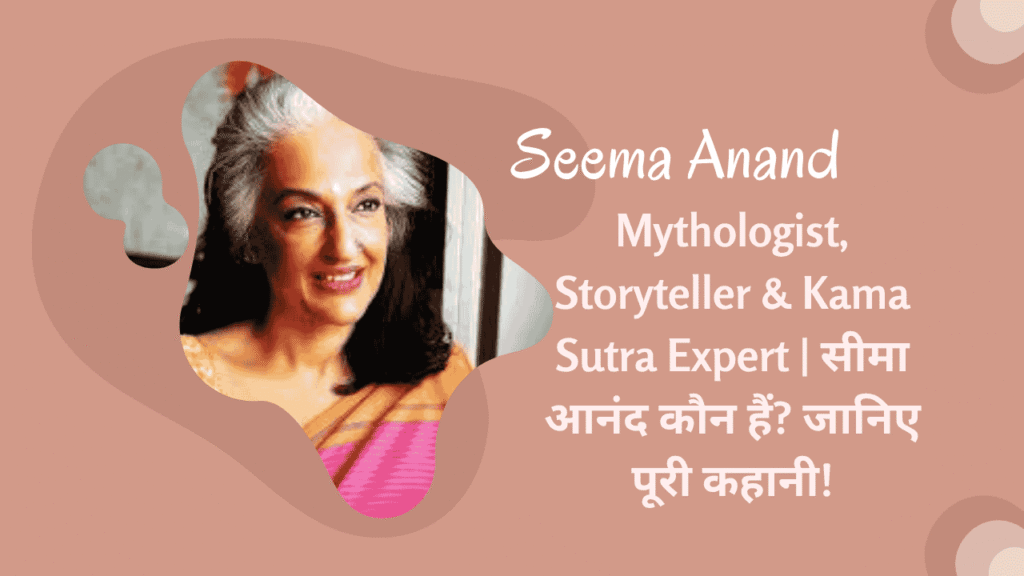
Seema Anand is a London-based mythologist redefining the Kama Sutra as a guide to emotional wisdom, female agency & ancient Indian storytelling tradition.
Seema Anand — सीमा आनंद: The Woman Who Gave Ancient India Its Voice Back
Dr. Anand
Narrative Expert • Author • Wisdom Keeper
Professional Background
Narrative Expert: She holds a PhD in Narrative Practices (Narratology) and uses storytelling for therapy, education, and corporate leadership training.
Author of influential works:
- The Arts of Seduction An exploration of ancient erotic wisdom
- Speak Easy: A Field Guide to Love, Longing and Intimacy A modern look at relationship dynamics
Cultural Work: Her research into ancient folklore is affiliated with a UNESCO initiative to preserve endangered oral traditions. She also lectures on major Indian texts like the Mahabharata, Puranas, and Bhagavad Gita.
Key Themes & Advocacy
Pleasure Education
Focuses on removing the shame associated with sexual desire, particularly for women, advocating for “pleasure” as a fundamental right.
Modern Relevance
Bridges ancient wisdom with contemporary issues such as consent, AI in relationships, and conscious ageing.
Digital Presence
Massive following on YouTube and Instagram. Known for her elegant storytelling style and graceful presence in traditional Indian attire.
Recent Public Discourse
In early 2026, Dr. Anand faced significant online harassment following viral podcast clips where she discussed topics like attraction between younger men and older women.
She has since become a powerful advocate against the weaponization of AI after being targeted by deepfake technology. Using her experience, she continues to highlight “rapist psychology” and the urgent need for women to feel safe and respected in digital spaces.
Seema Anand (born August 18, 1962) is a London-based mythologist, narratologist, and storyteller widely regarded as one of the most authoritative modern voices on ancient Indian erotic literature, oral traditions, and the philosophy of desire. She holds a PhD in Narrative Practices and has spent decades dismantling the popular Western reduction of the Kama Sutra into a mere “sex manual,” repositioning it as a sophisticated Sanskrit treatise on social harmony, emotional intelligence, and a woman’s sovereign right to pleasure. Her work sits at the rare intersection of academic rigour, cultural preservation, and radical accessibility — making her equally compelling to scholars, feminists, and everyday readers discovering India’s classical wisdom for the first time.
Who Is Seema Anand
She is a storyteller in the truest classical sense — someone trained not just in content, but in the ancient Indian art of kathakaara, where the narrator is as transformative as the text itself. Affiliated with a UNESCO initiative to preserve endangered oral traditions, Anand has dedicated her career to ensuring that India’s narrative heritage does not quietly vanish under the weight of colonial misinterpretation. She lectures extensively on the Mahabharata, the Puranas, and the Bhagavad Gita, drawing connections between these ancient texts and contemporary dilemmas around consent, ageing, loneliness, and even artificial intelligence in human relationships. Her academic foundation gives her arguments an authority that separates her sharply from influencers who casually appropriate spiritual or ancient content without depth.
Books and Intellectual Legacy
Her authorship reflects the breadth of her thinking. The Arts of Seduction delves into the erotic wisdom of antiquity, not as titillation, but as a philosophical framework for human connection. Speak Easy: A Field Guide to Love, Longing and Intimacy translates that ancient framework into the language of modern relationships, addressing desire, vulnerability, and emotional literacy in ways that resonate deeply with contemporary audiences. Both works have cemented her reputation as a thinker who refuses to separate the intellectual from the intimate. Beyond books, she has built a formidable digital presence on YouTube and Instagram, where her signature combination of traditional attire, unhurried narration, and unapologetic content has earned her a devoted global following.
The Kama Sutra Reframe — Her Most Defining Contribution
The single most significant thread running through all of Anand’s work is her reinterpretation of the Kama Sutra. She argues compellingly that the text’s 64 Arts — which include things as seemingly unrelated as flower arranging, culinary skill, and sleight of hand — are not decorative extras but are in fact the architecture of intimacy itself. To her, these arts represent the cultivation of a whole human being, someone so richly alive in their senses and presence that desire becomes a natural consequence of their existence rather than a performance. Her reading of the text’s stance on female agency is particularly striking: she highlights passages that explicitly defend a woman’s right to pleasure and choice, arguing that the ancient Indians were in certain ways more progressive about women’s autonomy than many modern societies dare to be.
Controversies and Criticism
No significant public figure is without their fault lines, and Anand is not exempt. Her content — particularly podcast appearances in which she discusses topics like attraction between younger men and older women — has triggered intense online backlash, with critics accusing her of normalising age-gap dynamics or sensationalising ancient texts for viral reach. Detractors from more conservative Hindu communities have at times questioned whether a London-based, Western-educated academic has the cultural standing to speak authoritatively about sacred Indian traditions, framing her reinterpretations as selective or stripped of their spiritual context. There is also a recurring critique that her corporatisation of storytelling — offering narrative-based leadership training to companies — risks commercialising what was originally a sacred oral tradition, potentially diluting its meaning for profit.
The Deepfake Crisis and Digital Harassment
In early 2026, Seema Anand became the unwilling centre of a deeply disturbing public controversy when she was targeted by deepfake technology following the viral spread of her podcast clips. The AI-generated content was weaponised as a form of harassment, and Anand responded not with silence but with direct, unflinching advocacy. She publicly named what she experienced as “rapist psychology” — the use of technology to violate, silence, and punish women who speak openly about desire and the body. Her response transformed a personal assault into a wider cultural conversation about the safety of women in digital spaces and the urgent need for legal and ethical frameworks around AI-generated imagery. This episode revealed a dimension of her character that goes beyond scholarship: a willingness to absorb personal harm in service of a larger truth.
What Makes Her Polarising — and Powerful
The tension at the heart of Seema Anand’s public life is precisely what makes her worth paying attention to. She occupies a space that makes many people uncomfortable — she is educated, elegant, and articulate while speaking freely and without apology about female desire, ancient eroticism, and the politics of pleasure. Supporters see her as a liberator restoring India’s own intellectual and sensual heritage back to Indian women. Critics see a figure who occasionally overreaches, either academically or culturally, in her interpretations. Both reactions confirm that she has done something rare: she has made an ancient text feel urgently, uncomfortably relevant in 2026 — which is, by any honest measure, the mark of a storyteller doing exactly what storytellers have always been meant to do.

