


- Introduction
- Who Is Sai Pallavi?
- Early Life — Erode, Dance, and the Medical Detour
- Premam — The Breakthrough That Changed Everything
- Fidaa and the Telugu Breakthrough
- Rowdy Baby — The YouTube Record
- Paava Kadhaigal, Shyam Singha Roy, and Gargi — The Range
- Love Story and Virata Parvam — Telugu Dominance
- Amaran — The Biggest Box Office Hit of Her Career
- The Ramayana Controversy — 2026
- Ek Din — The Bollywood Debut
- Ramayana — Sita, Diwali 2026
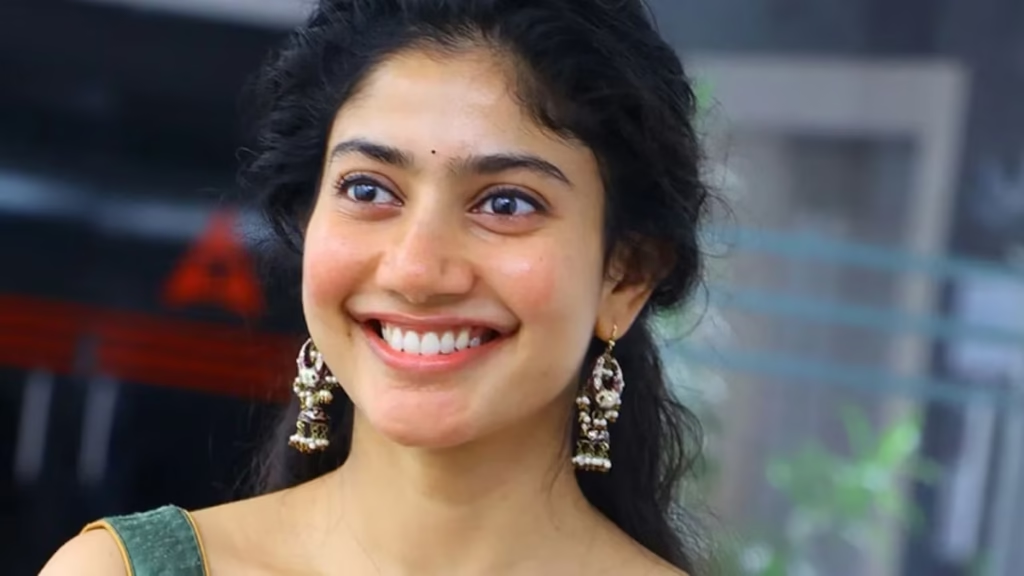
- The Natural Beauty Principle — No Filters, No Compromise
- Dancing and Physical Performance
- Awards and Critical Recognition
- Personal Life — Private, Principled, and Purposeful
- Why Sai Pallavi Inspires Millions
- Frequently Asked Questions
- How old is Sai Pallavi in 2026?
- Is Sai Pallavi a doctor?
- What is the Ramayana controversy about Sai Pallavi?
- When is Sai Pallavi's Bollywood debut?
- What is Amaran and how well did it perform?
- What is Sai Pallavi's role in Ramayana?
- What is Rowdy Baby?
- Why is Sai Pallavi called the Natural Beauty?
- How many Filmfare Awards South has Sai Pallavi won?
- What was Sai Pallavi's breakthrough role?
- What is Sai Pallavi's net worth in 2026?
Sai Pallavi complete biography 2026 — from Chennai dance competitions to pan-Indian superstardom. Full career story, Premam, Fidaa, Shyam Singha Roy, Gargi, Amaran, Ek Din Bollywood debut, Ramayana as Sita, Hindi language controversy, and net worth 2026.
Introduction
Sai Pallavi Senthamara Krishnan — born on May 9, 1992, in Kotagiri, Tamil Nadu, and raised in Erode — is one of the finest and most naturally gifted actresses working in Indian cinema today, an MBBS graduate who chose performance over medicine, a trained dancer whose movement vocabulary sets her apart from every contemporary peer, and the actress who has built the most consistent record of critical and commercial achievement across three film industries simultaneously — Telugu, Tamil, and Malayalam — without compromising the specific principles of authenticity, minimal makeup, and performance-first role choices that her audience recognises as inseparable from her identity. She is, at thirty-three years old, standing at the threshold of the most commercially significant phase of her career — two major Hindi film releases in 2026, one of which is the most anticipated Indian film production in years.
As of April 2026, Sai Pallavi is at the centre of one of the most intense casting controversies in contemporary Bollywood — a social media storm surrounding her casting as Sita in director Nitesh Tiwari’s two-part Ramayana, scheduled for Diwali 2026, opposite Ranbir Kapoor as Rama, Yash as Ravana, and Sunny Deol as Hanuman. A vocal section of social media users has questioned her Hindi fluency and demanded that an actress with native-level Hindi proficiency play Sita — a role they consider too culturally and religiously significant for a South Indian actress whose conversational Hindi carries a visible regional accent. The backlash escalated into a boycott trend, with clips of her speaking Hindi in interviews circulated widely as evidence of her alleged unsuitability. The industry response was equally vocal. Aamir Khan — who is producing her Bollywood debut Ek Din — publicly described her as “the best” when directly asked about the Ramayana controversy. Film industry professionals, critics, and large sections of the public pointed out the historical absurdity of the language objection: Sita, as a princess of the Mithila kingdom of ancient Nepal, would historically have spoken Maithili — not any form of modern Hindi. Comparisons were drawn to Katrina Kaif, Jacqueline Fernandez, and other non-native Hindi speakers who built substantial Bollywood careers while developing the language through their work rather than bringing it fully formed. Sai Pallavi herself has addressed rumours that emerged during the controversy — including a fabricated story that she was giving up non-vegetarian food for the role — with the directness she is known for, threatening legal action against any outlet publishing fabricated stories about her. The controversy is ongoing as of April 2026 and her Bollywood debut Ek Din, releasing May 1, 2026, lands in theatres against this specific background of fierce public debate about whether she belongs in Hindi cinema at all. The answer her career provides — seven Filmfare Awards South, the highest-grossing film of both her own and Sivakarthikeyan’s careers in Amaran (2024), and twelve years of consistent pan-Indian critical acclaim — is more persuasive than any social media boycott. She grew up in Erode in a Tamil household, attended medical college in Tbilisi, Georgia, completed her MBBS degree, and then chose acting over a medical career — a decision that has produced one of the most singular artistic identities in modern Indian cinema, built role by role, performance by performance, over twelve years of deliberate, uncompromising creative choices.
Who Is Sai Pallavi?
Sai Pallavi is an Indian actress and trained dancer who works across Telugu, Tamil, and Malayalam cinema and who is making her Hindi film debut in 2026. She is an MBBS graduate from Tbilisi State Medical University in Georgia who chose acting over medicine. She is known throughout Indian cinema as the “Natural Beauty” for her refusal to wear heavy makeup, use skin-lightening filters, or conform to the cosmetic presentation conventions that mainstream Indian film has historically demanded of its female stars. She has won seven Filmfare Awards South — including Best Actress (Telugu) for Fidaa (2017) and Love Story (2021) — and is currently filming Nitesh Tiwari’s Ramayana as Sita, releasing Diwali 2026.
| Detail | Info |
|---|---|
| Full Name | Sai Pallavi Senthamara Krishnan |
| Date of Birth | May 9, 1992 |
| Birthplace | Kotagiri, Tamil Nadu |
| Raised In | Erode, Tamil Nadu |
| Education | MBBS, Tbilisi State Medical University |
| Breakthrough Role | Malar — Premam (2015, Malayalam) |
| Bollywood Debut | Ek Din (May 1, 2026) |
| Ramayana Role | Sita (Diwali 2026) |
| Filmfare Awards South | 7 wins |
| Net Worth (2026) | ~₹100–120 Crore |
Early Life — Erode, Dance, and the Medical Detour
Sai Pallavi grew up in Erode — a textile and agricultural city in western Tamil Nadu — in a Tamil-speaking household where both her parents instilled the discipline and intellectual seriousness that would take her simultaneously into dance training and eventually into a medical degree. She began dance training as a young child and participated in multiple competitive dance programmes — including the television reality competition D 4 Dance on Mazhavil Manorama in 2014, where she appeared alongside her sister Pooja Kannan and where her performance generated significant public attention within the Malayalam entertainment community. Her academic record was strong enough to support enrollment in Tbilisi State Medical University in Georgia, where she completed her MBBS degree — a genuine professional qualification in medicine that most people who complete it go on to use as their primary career. She chose not to. She chose acting while still in medical school — a decision that required managing both the academic demands of a medical degree and the professional demands of an emerging film career simultaneously, a combination that reflects the same organisational discipline and intellectual rigour that her medical training required. Her sister Pooja Kannan is also a dancer and actress, making the Senthamara Krishnan household one of the most creatively engaged family units in South Indian entertainment.
Premam — The Breakthrough That Changed Everything
Premam (2015), directed by Alphonse Puthren for Malayalam cinema, is the film that introduced Sai Pallavi to pan-Indian audiences and established the specific qualities of her screen presence that every subsequent role has built on. She played Malar — a college lecturer who becomes the object of the protagonist George’s adult love, after two earlier failed romances, in a film whose third act Malar chapter is universally considered its emotional peak. The role required a combination of quiet dignity, genuine warmth, and the specific emotional intelligence of a woman who has already experienced enough of life to recognise what is worth protecting and what must be let go. Sai Pallavi’s Malar was instantly beloved — not because the role was showy or technically demanding in the way that awards-circuit performances typically are, but because she brought to it the complete naturalistic truth of a real person rather than a cinematic construct. Premam became one of the highest-grossing Malayalam films of 2015 and a pan-Indian streaming phenomenon when it reached wider audiences online. And Sai Pallavi was never available for the ordinary career path after Premam — she had demonstrated something in that role that the audience and the industry could not unsee, and both wanted more of it immediately.
Fidaa and the Telugu Breakthrough
Fidaa (2017), directed by Sekhar Kammula for Telugu cinema, gave Sai Pallavi her first major Telugu lead role — she played Bhanumathi, a strong-willed, village girl from Telangana whose personality, dialect, and energy drive a cross-cultural romantic drama in which she falls for a Telugu-American NRI played by Varun Tej. The role demanded absolute commitment to regional authenticity — Bhanumathi speaks in a specific Telangana dialect with a physicality and cultural specificity that urban Telugu cinema rarely engages with that seriously — and Sai Pallavi delivered it with the complete, unguarded naturalism that had made Malar memorable. The film was a massive commercial success, and the critical response to her performance was unanimous — she won the Filmfare Award South for Best Actress (Telugu) for the first time, establishing a pattern of Telugu industry recognition that she has maintained consistently since. Fidaa also produced one of her most celebrated dance sequences, demonstrating that the dancer’s physical intelligence she had developed through years of training was a commercial performance asset as well as a personal discipline.
Rowdy Baby — The YouTube Record
The song Rowdy Baby from the Tamil film Maari 2 (2018), featuring Sai Pallavi dancing alongside Dhanush, became one of the most-watched Indian music videos in YouTube history — accumulating over 900 million views, a number that contextualises her cultural reach across South Indian cinema with the kind of quantified evidence that critical acclaim alone cannot provide. Her performance in Rowdy Baby is a masterclass in commercial dance — the combination of technical precision, physical expressiveness, infectious energy, and the specific quality of complete enjoyment that makes a dance performance genuinely irresistible rather than merely accomplished. The song’s viewership trajectory directly demonstrated that her appeal to general audiences extended far beyond the art-house and performance-cinema spaces that her role choices might suggest she primarily occupies. Rowdy Baby made her a mass entertainer in the commercial, popular sense — a dimension of her public identity that her later success in films like Amaran and Love Story confirmed was deep and genuine rather than a single viral moment.
Paava Kadhaigal, Shyam Singha Roy, and Gargi — The Range
Three films across 2021 released within months of each other demonstrated the full breadth of Sai Pallavi’s dramatic range more comprehensively than any single production could have. Paava Kadhaigal (2020, Netflix anthology), specifically the short film Vaanmagal directed by Sudha Kongara, gave her one of the most emotionally devastating roles of her career — a mother confronting the honour killing of her daughter — a role whose sustained grief and moral fury she played without melodrama, which is the hardest possible way to play it. Shyam Singha Roy (2021), directed by Rahul Sankrityan for Telugu cinema, placed her in a dual timeline supernatural narrative where she played a Devadasi dancer in colonial Kolkata, demonstrating the kind of period physicality and historical emotional register that her dance training specifically enables. Gargi (2022), directed by Gautham Ramachandran for Tamil cinema, is widely considered one of the finest performances of her career — she played a schoolteacher who fights alone through the Indian legal system to defend her father from false sexual abuse charges, in a film whose moral rigour and Sai Pallavi’s performance together make it one of the most important Tamil films of its decade. The combination of Paava Kadhaigal, Shyam Singha Roy, and Gargi within a single creative phase established beyond any argument that she is not simply a natural beauty or a dancer-actress but a genuine dramatic talent of the first order.
Love Story and Virata Parvam — Telugu Dominance
Love Story (2021), directed by Sekhar Kammula and co-starring Naga Chaitanya, reunited her with the director who had brought out her best work in Fidaa and delivered another Telugu commercial and critical success — she won her second Filmfare Award South for Best Actress (Telugu) for the film. The character of Mounica, a dance teacher from a lower-caste background navigating the structural violence of caste-based social opposition to her relationship, gave her the space to explore the specific combination of joy, dignity, and quiet resistance that her best roles consistently require. Virata Parvam (2022), directed by Venu Udugula, placed her opposite Rana Daggubati in a period Naxalite drama that drew critical acclaim for her portrayal of Vennela — a village girl whose emotional world is shaped by radical political poetry she has never directly encountered — and further confirmed that her dramatic range was expanding rather than consolidating into a comfortable register.
Amaran — The Biggest Box Office Hit of Her Career
Amaran (2024), directed by Rajkumar Periyasamy and based on the life of Major Mukund Varadarajan — the Ashok Chakra-awarded Indian Army officer killed in a counter-insurgency operation in Kashmir in 2014 — is the highest-grossing film of Sai Pallavi’s career and the most commercially successful film Sivakarthikeyan has ever appeared in. She played Indhu Rebecca Varghese, Major Mukund’s wife — a real person whose emotional journey from military spouse to widow who must find the strength to celebrate her husband’s sacrifice forms the film’s most powerful thread. The film crossed Rs 100 crore worldwide within its first four days of release, reached Rs 211.70 crore in 29 days, and ultimately crossed Rs 328 crore worldwide — making it the eighth-highest-grossing Tamil film of all time at the point of its theatrical run. Her performance was described unanimously by critics as the emotional engine of the film — the quality that elevates a military biopic from tribute to genuine dramatic experience. She received multiple Best Actress nominations and won the SIIMA Best Actress Award at SIIMA 2025 for the performance. Amaran arriving on Netflix subsequently gave her performance a second viewing cycle that regenerated significant audience and critical conversation.
The Ramayana Controversy — 2026
The announcement of Sai Pallavi’s casting as Sita in Nitesh Tiwari’s two-part Ramayana — a production described as the most expensive Indian film ever made, produced by Namit Malhotra’s Prime Focus Studios with a budget reported to exceed ₹700–800 crore — was followed within months by a sustained social media controversy that continues as of April 2026. The objection circulating most widely online is that her Hindi is not fluent enough for the role — an argument illustrated by viral clips of her speaking Hindi in interviews, where her regional Tamil accent is clearly present. The boycott hashtags that emerged from this conversation reached significant Twitter trending volumes. The counterarguments from supporters, critics, and industry figures are more compelling than the objection. Historically, Sita was a princess of Mithila — the ancient kingdom occupying parts of present-day Nepal and Bihar — and her native language would have been Maithili, a language entirely distinct from Hindi; applying a modern Hindi-fluency requirement to a character from the Treta Yuga is historically incoherent. Professionally, Aamir Khan — whose production company Aamir Khan Productions is releasing her Bollywood debut Ek Din just months before Ramayana — publicly stated she is “the best” when directly asked about the controversy, a endorsement from one of Hindi cinema’s most selective and respected creative voices. The comparison to Katrina Kaif and Jacqueline Fernandez — both of whom built sustained Bollywood careers without native Hindi fluency — reflects the standard industry practice that has governed Hindi cinema for decades. Sai Pallavi has addressed fabricated stories that emerged during the controversy — specifically denying a widely circulated story that she was giving up non-vegetarian food for the role — and threatened legal action against outlets publishing fabricated content about her.
Ek Din — The Bollywood Debut
Ek Din (May 1, 2026), directed by Sunil Pandey and written by Sneha Desai and Spandan Mishra, is Sai Pallavi’s formal Hindi film debut — a romantic drama produced by Aamir Khan Productions in which she plays opposite Junaid Khan, Aamir Khan’s son, in what the teaser describes as “some stories don’t need time.” The film’s music, featuring Arijit Singh on the soundtrack, generated strong advance attention with critics noting the soulful quality of its lead track. The production is Aamir Khan’s direct personal investment in Sai Pallavi’s Hindi cinema transition — a fact whose significance cannot be overstated. Aamir Khan’s production choices are famously selective, and his decision to stake the credibility of Aamir Khan Productions on a film introducing Sai Pallavi to Hindi-language audiences reflects a level of professional confidence in her that the social media controversy about her Hindi fluency does not disturb. For Junaid Khan, Ek Din is his second theatrical release after Loveyapa (2026) — giving him a second opportunity to establish a commercial theatrical identity alongside one of South Indian cinema’s most compelling stars.
Ramayana — Sita, Diwali 2026
Nitesh Tiwari’s Ramayana is the most anticipated Indian film production of the current era — a two-part adaptation of the Valmiki Ramayana produced by Namit Malhotra, starring Ranbir Kapoor as Rama, Sai Pallavi as Sita, Yash as Ravana, Sunny Deol as Hanuman, Ravi Dubey as Lakshmana, and Vivek Oberoi in a supporting role. The first part is scheduled for Diwali 2026 theatrical release. Nitesh Tiwari’s previous film Dangal (2016) crossed ₹2,000 crore worldwide — a benchmark that makes the commercial expectations attached to Ramayana among the most enormous in Indian cinema history. Sai Pallavi’s casting as Sita places her at the narrative and emotional centre of both parts — Sita’s journey from Mithila to Lanka and back to Ayodhya is the moral and spiritual axis of the Ramayana, and the performance required of whoever plays her is one of extraordinary emotional range, from serene dignity to desolation to transcendent resolve. Tiwari’s selection of Sai Pallavi — a choice made in full awareness of the language controversy it would generate — reflects exactly the kind of performance-centred casting logic that the strongest directors apply regardless of social media pressure.
The Natural Beauty Principle — No Filters, No Compromise
Sai Pallavi’s decision to appear on screen without heavy makeup, without skin-lightening filters, without the cosmetic enhancement that Indian cinema has historically normalised as the baseline presentation for female stars, is not simply a personal aesthetic preference. It is a conscious, sustained, publicly articulated creative and ethical position. She has spoken about the influence her natural appearance has on young women who watch her films — describing instances where young girls saw someone on screen who looked like them and drew from that resemblance a sense of belonging and worth that sanitised, filtered beauty standards deny them. The “Natural Beauty” designation that her audience has given her is not simply about what she looks like — it is about what her choice to look that way communicates about whose appearance is allowed to be heroic, desirable, and worthy of the centre of the screen. That position has commercial consequences — it has occasionally generated criticism from older industry voices — and she has maintained it across twelve years of professional work regardless. It is, in that consistency and that cost, a genuine artistic statement.
Dancing and Physical Performance
Dance is not simply one of Sai Pallavi’s skills — it is the foundational physical intelligence from which her entire performance vocabulary is built. She trained in Bharatanatyam, folk, and Western dance styles from childhood, competed in television dance reality shows, and brings to every performance a specific bodily awareness and expressiveness that actors without serious dance training cannot replicate through technique alone. The commercial dance sequences in her films — Rowdy Baby, the Fidaa songs, the Shyam Singha Roy Devadasi sequences — each demonstrate different registers of her physical range, from folk-inflected jubilance to classical discipline to commercial energy. And in non-dance scenes, the dancer’s precision is visible in how she occupies physical space — the weight of stillness she can project, the micro-physical adjustments that convey emotional states before dialogue, the complete absence of unnecessary movement that marks performers who have spent thousands of hours in conscious relationship with their own bodies.
Awards and Critical Recognition
Sai Pallavi’s awards record reflects a consistent critical consensus across three film industries spanning twelve years. She has won seven Filmfare Awards South — including Best Actress (Telugu) for Fidaa (2017) and Love Story (2021), Best Actress (Tamil) for Gargi (2022) and Amaran (2024), and Best Actress (Malayalam) for Premam (2015). She has won the SIIMA Best Actress Award multiple times, the South Indian International Movie Award, and a broad range of state film awards across Tamil Nadu, Andhra Pradesh and Telangana, and Kerala. She received the National Film Award consideration for Gargi — widely discussed as one of the most deserving performance-based nominations of that awards cycle. And her consistent presence at the top of pan-Indian audience preference polls and digital engagement metrics confirms that her critical standing and commercial appeal are inseparable rather than in tension, the combination that defines genuine artistic authority in Indian cinema.
Personal Life — Private, Principled, and Purposeful
Sai Pallavi has maintained an extremely private personal life throughout twelve years of escalating public attention — one of the most consistently private professional personas in Indian entertainment at her level of fame. She has not confirmed any romantic relationships publicly, does not engage with tabloid speculation about her personal life, and has focused the entirety of her public communication on her work, her values around natural beauty and authentic performance, and occasional direct responses to misinformation — most recently the Ramayana vegetarianism rumour, which she addressed sharply and with the threat of legal action. She lives primarily in Chennai and is close with her family, particularly her sister Pooja Kannan who has shared the entertainment industry path alongside her. Her MBBS qualification gives her a professional identity entirely separate from acting — a foundation that she has said gives her a sense of security and self-definition that does not depend on the film industry’s approval. That independence is visible in every career choice she has made.
Why Sai Pallavi Inspires Millions
Sai Pallavi’s story is for every person who was told that they needed to look different, speak a different language, come from a different place, or change something fundamental about themselves to belong in a space they had already earned through the quality of their work. She became the most celebrated new actress in Malayalam cinema looking exactly like herself. She became the highest-grossing actress in Telugu cinema looking exactly like herself. She is about to appear as Sita in the most expensive Indian film ever made looking exactly like herself. And when social media demanded that she speak better Hindi or step aside, the response from the people whose judgment actually matters — Aamir Khan, Nitesh Tiwari, the audience that made Amaran cross ₹328 crore — was complete and unambiguous. So the lesson of her career is not about the natural beauty principle or the MBBS degree or the dance training or the seven Filmfare Awards. It is about what happens when a person knows exactly who they are, refuses to negotiate any part of it, and then simply does the work.
Frequently Asked Questions
How old is Sai Pallavi in 2026?
She was born on May 9, 1992, making her 33 years old as of April 2026. She turns 34 in May 2026.
Is Sai Pallavi a doctor?
Yes. She completed her MBBS degree from Tbilisi State Medical University in Tbilisi, Georgia, obtaining a full medical qualification before choosing to pursue acting as her primary career rather than practicing medicine.
What is the Ramayana controversy about Sai Pallavi?
A section of social media users has objected to her casting as Sita in Nitesh Tiwari’s Ramayana, arguing that her Hindi carries a visible regional Tamil accent and that the role requires native Hindi fluency. Supporters have responded that historically Sita spoke Maithili — not Hindi — making the language objection historically incoherent, and that her acting credentials far exceed the requirement of the role. Aamir Khan publicly described her as “the best” when asked about the controversy.
When is Sai Pallavi’s Bollywood debut?
Her Hindi film debut, Ek Din — directed by Sunil Pandey and produced by Aamir Khan Productions — releases on May 1, 2026. She stars alongside Junaid Khan, son of Aamir Khan, in a romantic drama with a soundtrack featuring Arijit Singh.
What is Amaran and how well did it perform?
Amaran (2024) is a Tamil biographical action film directed by Rajkumar Periyasamy, based on the life of Major Mukund Varadarajan. Sai Pallavi played the Major’s wife Indhu Rebecca Varghese. The film crossed ₹328 crore worldwide, making it both the highest-grossing film of her career and the highest-grossing film Sivakarthikeyan has appeared in. She won the SIIMA Best Actress Award for her performance.
What is Sai Pallavi’s role in Ramayana?
She plays Sita — opposite Ranbir Kapoor as Rama, Yash as Ravana, and Sunny Deol as Hanuman — in Nitesh Tiwari’s two-part Ramayana, scheduled for Diwali 2026 theatrical release. It is described as the most expensive Indian film production ever made.
What is Rowdy Baby?
Rowdy Baby is a dance number from the Tamil film Maari 2 (2018) featuring Sai Pallavi and Dhanush. It has accumulated over 900 million views on YouTube, making it one of the most-watched Indian music videos in the platform’s history and the single most commercially visible demonstration of Sai Pallavi’s dance talent.
Why is Sai Pallavi called the Natural Beauty?
She is called the Natural Beauty because she consistently appears on screen without heavy makeup, without skin-lightening filters, and without the cosmetic enhancement conventions that Indian cinema has historically normalised for female stars. She has spoken about this choice as a deliberate ethical and artistic position — one she maintains because of its impact on young women who see someone who looks like them at the centre of a film.
How many Filmfare Awards South has Sai Pallavi won?
She has won seven Filmfare Awards South — including Best Actress (Telugu) for Fidaa (2017) and Love Story (2021), Best Actress (Tamil) for Gargi (2022) and Amaran (2024), and Best Actress (Malayalam) for Premam (2015), alongside additional category wins across the same ceremony cycles.
What was Sai Pallavi’s breakthrough role?
Her breakthrough role was Malar in the Malayalam film Premam (2015), directed by Alphonse Puthren. The film became one of the highest-grossing Malayalam films of its year and her performance generated immediate pan-Indian recognition — establishing the naturalistic, emotionally intelligent performance identity that every subsequent role has built on.
What is Sai Pallavi’s net worth in 2026?
Her estimated net worth in 2026 is approximately ₹100–120 crore, built through twelve years of acting fees across Malayalam, Telugu, and Tamil cinema — including the massive commercial success of Amaran (2024) — and now expanding through Hindi film debut fees for Ek Din and Ramayana, the latter at the highest production budget in Indian film history.