


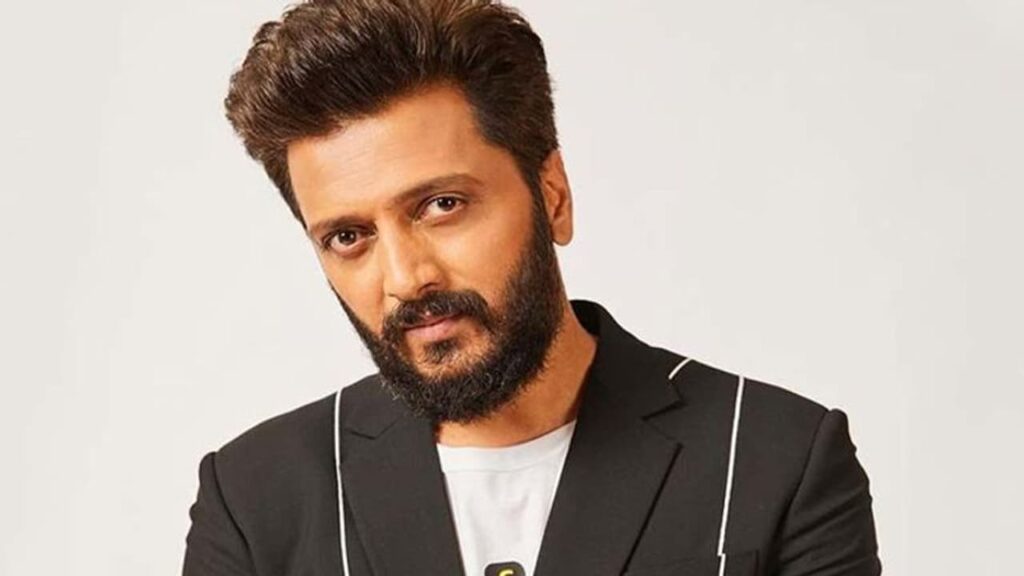
- Riteish Deshmukh – A Legacy Born in Latur
- The Architect Who Chose the Camera
- The Comedy King: How He Owned a Genre
- The Turn Nobody Expected: Ek Villain
- Marathi Cinema: The Identity That Was Always There
- The Personal Life That Became Public Love
- Imagine Meats: The Disruption Nobody Saw Coming
- 2026: The Year He Becomes a Director-Star
- Raja Shivaji — May 1, 2026
- Dhamaal 4 — July 3, 2026
- Untitled SRK-Suhana-Marflix Project
- 2027 and Beyond: The Pipeline That Never Stops
- Son of Sardaar 2
- Masti 4
- Untitled Salman Khan / Sooraj Barjatya Project
- The Wealth Behind the Work
- A Letter to the Son of Latur
Riteish Deshmukh – A Legacy Born in Latur
There is a particular kind of weight that comes with being the son of a Chief Minister. It is not merely expectation — it is inheritance of a public identity, a surname that arrives in every room before you do, and the impossible standard of measuring your own story against a life already written in the history books of a state. Riteish Vilasrao Deshmukh was born on December 17, 1978, in Latur, Maharashtra — a city that had given his father Vilasrao Deshmukh to Maharashtra politics and would eventually give the world something it did not expect: a man who could make a billion people laugh, move them to tears, design their offices, disrupt their food choices, and direct a historical epic about Chhatrapati Shivaji Maharaj, all within the same lifetime.
Latur is a city of dust, resilience, and deep Marathi pride. The 1993 earthquake that devastated it became one of the defining national tragedies of that decade, and it was Vilasrao Deshmukh’s administrative response to that catastrophe that first brought the Deshmukh name to statewide prominence. Growing up in the shadow of that legacy, Riteish was simultaneously privileged and burdened — a politician’s son in a state where politics is religion, expected to carry forward something enormous, without being given a clear answer to the question of how. He found his answer in architecture, comedy, Bollywood, Marathi pride, plant-based meat, and a historical film about Maharashtra’s greatest king. The biography of Riteish Deshmukh is not a straight line. It is a map with multiple destinations, all reached from the same stubborn starting point.
The Architect Who Chose the Camera
Before Bollywood claimed him, Riteish Deshmukh trained as an architect at D.G. Ruparel College in Mumbai, graduating with a professional qualification that most people in the entertainment industry have no idea he possesses. Architecture is not a casual credential — it is a discipline that trains the mind in spatial logic, structural integrity, proportion, and the relationship between form and function. He went on to use that qualification professionally, establishing his own architectural firm called Evolutions, through which he has designed offices for clients that include Shah Rukh Khan — placing him in the specific category of people who can credibly claim Shah Rukh Khan as both a professional client and a Bollywood co-star simultaneously.
The pivot to acting came through his debut film Tujhe Meri Kasam in 2003, which introduced him to the screen opposite Genelia D’Souza — a professional introduction that would eventually become the most important personal relationship of his life. The film was not a defining hit, but it established a presence. What came after was where the real story began.
The Comedy King: How He Owned a Genre
The phrase “comedy actor” is used carelessly in Bollywood — applied to anyone who plays a funny character, wears a costume, or lands a punchline. Riteish Deshmukh belongs to a different category entirely. He is one of the very few mainstream Bollywood actors who built genuine franchise equity in the comedy genre, whose name on a comedy poster carries actual commercial weight, and whose physical comedy and timing are a bankable asset rather than a supplementary skill.
The Housefull franchise is the clearest evidence of this. Across five instalments — with Housefull 5 releasing in 2025 — his participation became a defining element of what audiences expected from the series. Housefull 5’s commercial success reportedly contributed to a 16% jump in his overall net worth over four years, a direct financial reflection of the franchise’s continued viability with him in the ensemble. The Masti franchise, Dhamaal, and Kyaa Kool Hai Hum established the same principle across multiple productions. What makes his comedy work at scale is physical intelligence — he understands his own body in motion the way great physical comedians do: where to place a gesture, how long to hold an expression, the precise weight of a pause before a punchline. Combined with an ability to handle adult humour without ever tipping into discomfort, he built a comedy persona that was consistently bankable across two decades.
The Turn Nobody Expected: Ek Villain
The most significant single performance of Riteish Deshmukh’s acting career may also be the most surprising. In 2014, director Mohit Suri cast him as the primary antagonist in Ek Villain — a serial killer named Rakesh whose violence was not cartoonish but genuinely disturbing, rooted in emotional damage that made the character simultaneously threatening and tragic. The casting was a provocation. Nobody who had watched him across the Housefull franchise expected what he delivered — a performance of controlled menace and unexpected pathos that forced critics and audiences alike to recalibrate what they thought he was capable of. The film was a commercial and critical success, and his performance remains the single most discussed of his career.
That performance opened a door he had not previously been offered: the door to dramatic leading roles, to villains, to moral complexity. He did not walk through it immediately or completely — the comedy franchise work continued and remained commercially dominant — but it established permanently that the man playing the fool in Housefull could, when directed correctly, make the audience genuinely uncomfortable. That range is the most valuable thing an actor can possess.
Marathi Cinema: The Identity That Was Always There
Riteish Deshmukh’s relationship with Marathi cinema is not a career strategy — it is an identity. Born in Latur, raised with the cultural inheritance of Maharashtra, and carrying the political legacy of a father who served the state, his engagement with Marathi film was never optional. It was a debt of belonging, repaid across two decades with consistent creative and financial investment.
As a producer, he backed Balak-Palak, a Marathi film that tackled sex education with genuine courage and became a cultural event in Maharashtra. Yellow, another production, explored the life of a special needs child with a sensitivity that the mainstream Hindi industry rarely brings to such subjects. As an actor, Lai Bhaari and Mauli gave him leading man status in a regional industry that the Hindi film establishment has historically underestimated. His hosting of Bigg Boss Marathi Season 5 in 2024 placed him at the centre of Marathi popular culture’s most-watched television property — a role he inhabited with the same warmth and authority that Salman Khan brings to the Hindi version.
The through-line of his Marathi work is pride without condescension. He has never treated the regional industry as a lower tier or a side hustle. He has engaged with it as a parallel creative home, and that consistency has earned him a standing in Maharashtra that is separate from and in many ways more durable than his Bollywood reputation.
The Personal Life That Became Public Love
In 2012, Riteish Deshmukh married Genelia D’Souza — the co-star of his debut film, nine years after they first appeared on screen together. The marriage did not arrive suddenly; it arrived after years of a relationship that had been an open public secret in Bollywood, conducted with a degree of discretion that the industry rarely manages and audiences had long found charming. They have two sons — Riaan and Rahyl — and in the context of Raja Shivaji, their younger son Rahyl makes his acting debut, appearing in the film that his father wrote, directed, and stars in. The image of a father and son appearing together on screen in a film about Maharashtra’s greatest warrior is not a PR moment — it is a personal statement about legacy, inheritance, and the specific Marathi pride that runs through everything the Deshmukh family has built.
Genelia Deshmukh is not a passive presence in this story. She co-produced Raja Shivaji and is the co-founder of Imagine Meats, the plant-based meat startup the couple launched together. At the Raja Shivaji trailer launch on April 20, 2026, both of them were visibly emotional — a public moment of genuine feeling that reminded everyone watching that behind the franchise actor, the director, and the entrepreneur is a man for whom what he has built means something real and personal.
Imagine Meats: The Disruption Nobody Saw Coming
In 2020, Riteish and Genelia Deshmukh launched Imagine Meats — a plant-based meat brand targeting India’s enormous non-vegetarian market with products that replicate the taste and texture of meat without using animal products. The brand launched with a range including plant-based chicken, mutton, and keema products designed specifically for Indian cooking methods — a crucial distinction from Western plant-based brands that had largely failed in India by producing products suited to burger patties and sausages rather than curries, biryanis, and kebabs.
The business rationale was sharp. India has the world’s largest vegetarian population but also hundreds of millions of non-vegetarians for whom meat is culturally and nutritionally central. A product that could credibly replicate the sensory experience of meat for health-conscious, environmentally aware, or religiously motivated consumers was addressing a genuine market gap. The Deshmukhss celebrity equity provided initial visibility, but the product had to stand on its own after that — and the company’s continued operation and expansion suggest it has built a real consumer base beyond the novelty of a Bollywood couple’s startup.
Inc42 noted that Imagine Meats represents the kind of D2C venture that uses celebrity reach as a launchpad rather than a crutch — a distinction that separates genuinely entrepreneurial celebrities from those who simply lend their name to businesses they are not operationally invested in. The Deshmukhss built Imagine Meats from the product design stage, spent time on ingredient development and culinary adaptation, and positioned it within the specific cultural context of Indian cooking. That involvement is not superficial.
2026: The Year He Becomes a Director-Star
If any single year defines the full arc of everything Riteish Deshmukh has been building, it is 2026. Two major theatrical releases, a government ambassadorship, and a cultural reckoning with his own Marathi identity — all arriving simultaneously, all carrying the weight of decades of preparation.
Raja Shivaji — May 1, 2026
Raja Shivaji is the film that Riteish Deshmukh has been building toward his entire career, even if neither he nor anyone watching knew it until recently. Written, directed, produced, and starring Riteish himself, the film tells the story of Chhatrapati Shivaji Maharaj — the seventeenth-century Maratha warrior king who built an empire against the Mughal juggernaut through intelligence, courage, and an almost supernatural understanding of guerrilla warfare.
The film releases on May 1, 2026 — Maharashtra Day — a date that is not coincidental. Releasing a film about Maharashtra’s greatest historical hero on the day the state celebrates its own founding is a political and cultural statement as much as a commercial decision. It is Riteish Deshmukh, son of a Maharashtra Chief Minister, announcing through the most public medium available that the Deshmukh name and the Marathi identity are inseparable.
The cast assembled for this film is extraordinary by any measure. Sanjay Dutt plays Afzal Khan, the Bijapur Sultanate general whose encounter with Shivaji at Pratapgad is one of the most legendary moments in Maratha history. Abhishek Bachchan, Genelia Deshmukh, Fardeen Khan, Bhagyashree Patwardhan, Mahesh Manjrekar, Sachin Khedekar, Amole Gupte, Boman Irani, and Vidya Balan fill out an ensemble that spans multiple generations of Indian cinema. The cinematographer is Santosh Sivan — one of India’s most celebrated DPs, whose visual language for historical epics includes films like The Legend of Bhagat Singh and Asoka. The music is composed by Ajay-Atul, Maharashtra’s most beloved composer duo who have defined the sonic identity of Marathi cinema for two decades.
The film is released in six languages — Marathi, Hindi, Tamil, Telugu, Kannada, and Malayalam — a pan-India multilingual strategy that signals ambition beyond Maharashtra and beyond the Hindi belt, reaching south Indian markets with a story that belongs to all of India’s history, not just one state’s pride. The trailer launched on April 19, 2026, at a grand Mumbai event where Riteish and Genelia were visibly moved, and the Times of India described it as delivering “a visual spectacle”. This is his second directorial venture, following his debut with the Marathi blockbuster Ved, and it represents a quantum leap in scale, ambition, and personal stakes.
Dhamaal 4 — July 3, 2026
Less than three months after Raja Shivaji, Riteish Deshmukh returns to the franchise that has been one of the most reliable commercial vehicles of his career. Dhamaal 4, directed by Indra Kumar, reunites him with Ajay Devgn, Arshad Warsi, Javed Jaffrey, Sanjay Mishra, and Boman Irani — an ensemble of comedic firepower that represents the full inheritance of what Bollywood’s comedy franchise tradition has built over two decades.
The film is locked for release on July 3, 2026, positioning it as a summer blockbuster targeting the same mass family audience that made the earlier Dhamaal films consistent commercial hits. The casting of Riteish alongside Ajay Devgn in a comedy context is particularly interesting because both actors have spent recent years expanding their dramatic and directorial credentials — Ajay Devgn through Drishyam and his production ventures, Riteish through Raja Shivaji — before returning to the franchise comfort zone together. It is a reunion that carries the specific pleasure of watching people who are very good at something do that thing again, with the added weight of everything they have become in the years between.
Untitled SRK-Suhana-Marflix Project
Beyond the confirmed releases, Riteish Deshmukh is reported to have a key role in a highly anticipated collaboration involving Shah Rukh Khan and Suhana Khan — a project that would add his presence to one of the most commercially loaded casting combinations in contemporary Bollywood. Given his existing personal and professional relationship with Shah Rukh Khan — whose office he designed through Evolutions, and alongside whom he has appeared in multiple productions — his involvement would represent a natural continuation of a creative association that spans architecture, friendship, and cinema simultaneously.
2027 and Beyond: The Pipeline That Never Stops
Son of Sardaar 2
The sequel to the 2012 action-comedy is slated for 2027, starring Riteish alongside Ajay Devgn in a continuation of the original’s irreverent Punjabi-flavoured comedy-action format. International shooting has already begun, suggesting a production that is moving with real momentum rather than sitting in development limbo. The original Son of Sardaar was a significant commercial success, and the sequel inherits a built-in audience that has been waiting over a decade for a continuation.
Masti 4
Riteish reunites with Vivek Oberoi and Aftab Shivdasani for the fourth instalment of the Masti franchise — India’s most consistently profitable adult comedy series. Production was active in late 2025, with a 2027 theatrical release expected. The Masti films occupy a specific cultural lane that their audience returns to with remarkable loyalty, and the reunion of the original three leads after the franchise’s various reconfigurations over the years carries its own nostalgic charge.
Untitled Salman Khan / Sooraj Barjatya Project
Currently in early development, Riteish is rumoured to have a role in an upcoming Sooraj Barjatya directorial featuring Salman Khan — a combination that would place him in one of the most emotionally and commercially loaded cinematic spaces in Hindi film. Barjatya’s films are events, not movies — they define the tone of the year they release in — and Riteish’s presence in that universe would be a significant statement about where his career has arrived.
The Wealth Behind the Work
Riteish Deshmukh’s financial profile is the product of three parallel income architectures that have compounded across two decades. His film career alone — across comedy franchise royalties, acting fees, and his production company’s equity stakes — generates an income that places him comfortably among Bollywood’s top-earning working actors. Housefull 5’s commercial success in 2025 and the net worth jump of 16% it contributed to over four years reflects how franchise participation translates into sustained financial appreciation rather than one-time fee income.
His architecture firm Evolutions and his Imagine Meats startup represent business income that is entirely separate from the film industry, creating a financial resilience that few actors of his generation have deliberately built. Imagine Meats, with its D2C distribution model and celebrity-backed brand equity, operates in India’s fastest-growing food sector — the plant-based protein market that is being driven by health awareness, environmental consciousness, and India’s enormous and growing middle class. The Maharashtra State Road Transport Corporation ambassadorship, announced in April 2026 alongside Genelia Deshmukh for a five-year term, adds government-sector brand association to a portfolio that already spans entertainment, architecture, and food technology.
His estimated net worth stands at approximately Rs. 170–200 crore as of 2026 — a figure that reflects the full breadth of these income streams rather than a single industry’s valuation of his talent.
The Complete Career at a Glance
| Category | Notable Works |
|---|---|
| Comedy Blockbusters | Masti series, Housefull 1–5, Dhamaal series, Kyaa Kool Hai Hum |
| Dramatic / Critical | Ek Villain (antagonist), Marjaavaan, Lai Bhaari |
| Marathi Cinema | Lai Bhaari, Mauli; produced Balak-Palak and Yellow |
| Directorial | Ved (debut), Raja Shivaji (2026) |
| Television | Bigg Boss Marathi 5 host, Case Toh Banta Hai, Vikta Ka Uttar |
| Entrepreneurial | Evolutions (architecture), Imagine Meats (plant-based food) |
| Government Role | MSRTC Brand Ambassador (2026–2031, with Genelia Deshmukh) |
| Upcoming (2026) | Raja Shivaji (May 1), Dhamaal 4 (July 3), SRK–Suhana project |
| Upcoming (2027) | Son of Sardaar 2, Masti 4, Salman–Barjatya project |
A Letter to the Son of Latur
This is not analysis. This is acknowledgement.
To Riteish Vilasrao Deshmukh — the architect who designed offices before he filled cinemas, the comedian who made India laugh before he made it cry, the son of a Chief Minister who found his own way to serve Maharashtra not through politics but through cinema: you built something that nobody gave you a blueprint for.
You could have coasted on the Deshmukh name, collected franchise paycheques, and retired comfortably into the comfortable obscurity of the moderately famous. You chose instead to keep building — a production company, an architecture firm, a food startup, a directorial career, a Marathi film legacy, and now Raja Shivaji: a historical epic about Maharashtra’s greatest king, releasing on Maharashtra Day, starring your son in his acting debut, produced by your wife, shot by Santosh Sivan, scored by Ajay-Atul, and carrying the full weight of everything your family’s name has meant to that state for two generations.
That is not a film. That is a lifetime assembled into two hours. And whatever the box office says on May 2, 2026, the fact that it exists — that you made it, that you dared to make it — is the most Deshmukh thing you have ever done. Your father would have understood.

