


Table of Contents
Is Nakhchivan the Most Overlooked Place
There is a piece of Azerbaijan that does not touch Azerbaijan. It sits wedged between Iran to the south, Turkey to the west, and a country it technically shares a border with but cannot cross — Armenia — to the north and east. This is Nakhchivan, a fully autonomous republic within Azerbaijan that exists in a state of deliberate geographic contradiction, and for the handful of travelers who actually make it here, that contradiction turns out to be the most compelling reason to come. Most people flying into Baku never hear the name. European travel forums treat it as a footnote. American travelers who pride themselves on off-the-beaten-path credentials have almost certainly never considered it. That is a significant oversight.
Nakhchivan is not a destination that performs for you. It does not have curated Instagram trails, Airbnbs with rooftop bars, or a tourism board with a glossy international presence. What it does have is a fortress so dramatically positioned on a cliff edge that travel writers have taken to calling it the Machu Picchu of the Caucasus, a Soviet-era salt mine that doubles as a functioning medical spa, red rock canyons that feel ripped from the American Southwest, a floating island on a high-altitude lake, and a town called Ordubad that sits so close to Iran you can see across the border while standing at a medieval mausoleum. This guide is written for travelers from the UK, Germany, the United States, and across Europe who are drawn to places that still carry genuine weight — not manufactured authenticity, but the real, slightly uncomfortable, deeply rewarding kind that comes from going somewhere most people never thought to go.

Why Nakhchivan Carries a Weight That Most Destinations Cannot Fake
The first thing that strikes you about Nakhchivan from above, as your Azerbaijan Airlines flight descends from Baku, is the terrain. It is reddish, arid, and oddly Martian — nothing like the lush green mountains of northern Azerbaijan that most visitors associate with the country. This is a landscape shaped by geological violence and centuries of human struggle, and that combination has produced something that feels both ancient and strangely modern at the same time. The capital, Nakhchivan City, is meticulously planned, with wide Soviet-era boulevards that were built to project an image of orderly progress. The infrastructure is noticeably better than much of the surrounding region, with smooth roads that locals themselves describe as something that would have been unimaginable a decade ago.
A History That Refuses to Simplify
Nakhchivan’s recorded history stretches back thousands of years, and local tradition insists it goes back even further — to Noah himself. The supposed tomb of Noah sits within Nakhchivan City, and while archaeologists treat this with appropriate skepticism, the fact that such a legend persists speaks to just how deep the region’s sense of historical identity runs. The area sits on what was once a critical segment of the Silk Road, which explains why Alinja Castle was not merely a military fortress but also a center of trade and accumulated wealth. During the medieval period, the region passed through the hands of the Atabegs, the Hulakids, the Ilkhanids, and the Jalairids — and each left architectural and cultural fingerprints that are still visible today. The 14th-century siege by Timur’s armies, which lasted fourteen years without success, gives you a sense of just how formidable Alinja’s natural and constructed defenses actually were.
The Exclave Problem: Politics Baked Into Geography
For European travelers used to the seamless freedom of Schengen travel, Nakhchivan’s geopolitical reality is worth understanding before you arrive. This is a region that was blockaded by Armenia during the Nagorno-Karabakh conflict, cutting it off from mainland Azerbaijan for extended periods. That history of isolation has produced a kind of self-sufficiency that feels palpable on the ground — markets are well-stocked, roads are maintained, and the city center is clean in a way that reflects deliberate civic pride rather than tourism investment. The region shares borders with Iran and Turkey, which means its cultural influences are layered and complicated in ways that a simple “Azerbaijani destination” framing would completely miss. You cannot enter Nakhchivan overland from Armenia — that border remains closed — so visitors typically fly in from Baku on domestic flights, or enter from Turkey through the Sadarak border crossing or from Iran through Julfa.
The Soviet Layer Nobody Warned You About
If you traveled through Central Asia or Eastern Europe before the cultural renovations of the 2010s began erasing Soviet architectural heritage, Nakhchivan will feel familiar in a way that is more nostalgic than oppressive. The wide planned boulevards, the government buildings in that particular utilitarian style, and the sense that the city was designed to function rather than to charm are all here. But unlike Minsk or Tiraspol, Nakhchivan does not feel trapped in that aesthetic — it has layered new construction and ancient monuments into the Soviet skeleton rather than choosing one over the other. That palimpsest quality, where multiple historical eras are visible simultaneously, is something European architecture lovers will find genuinely interesting rather than simply curious.
Alinja Castle: The Comparison to Machu Picchu Is Bolder Than It First Sounds
The Machu Picchu comparison was originally coined by local tour agencies and guidebooks looking for a shorthand that Western travelers would immediately grasp, and on one level it is an obvious marketing move. But stand at the base of Mount Alinja and look up at the fortress clinging to its cliff face, then look out at the valleys and villages spread below, and the comparison starts to feel less like promotion and more like an honest attempt to prepare you for the scale of what you are about to see. Both Machu Picchu and Alinja are stabilized ancient ruins in locations that seem to defy the logic of construction, both are backed by dramatic rocky outcrops, and both reward the physical effort required to reach them with views that justify every step.
What the Climb Actually Demands
The ascent to Alinja takes approximately forty to forty-five minutes at a steady pace, and you should plan to spend at least two hours at the site in total. In summer, the heat on the exposed rock face is real and the climb is physically demanding — bring considerably more water than you think you need. The fortress dates back to at least the 1st–6th centuries CE by estimated construction periods, though its documented history begins in the 12th century. Three main sections divide the complex across northern, northwestern, and southwestern areas, connected by stone steps and punctuated by the remains of eight defensive walls and semicircular towers built from large stones and burnt bricks. A small museum at the base houses reconstructed defensive elements and ancient artifacts, and the staff — who will likely be the only people there when you visit — are genuinely warm and interested in the rare foreign visitor. Restoration work began in 2014 and has revived much of the site’s physical integrity without turning it into a sanitized heritage park.
Getting There
Alinja Castle sits near Alinja village in the Julfa district, and there is no reliable public transport to the trailhead. Most travelers negotiate a round-trip taxi from Nakhchivan City, which will cost approximately 60 AZN (roughly €32 / $34) for the round trip including waiting time. Hiring a driver for the day rather than a metered taxi gives you more flexibility and is standard practice here.
The Red Canyons Near Arafsa: The Southwest That Ended Up in the Caucasus
One of the most unexpected visual experiences in Nakhchivan is the red rock canyon landscape near Arafsa, which has been described by multiple travelers as a miniature Grand Canyon. The comparison is not as dramatic as the Alinja-Machu Picchu parallel, but the reddish-orange rock formations cut through by winding roads carry a genuine visual drama that feels entirely out of place for a small autonomous republic in the South Caucasus. Driving through this landscape is one of those travel experiences that earns its reputation through the sheer surprise of it — most visitors arrive expecting historical monuments and leave talking about the canyons.
For American travelers from the Mountain West or the Southwest, there will be a disorienting familiarity here — the color palette, the dry air, the scale of the formations all rhyme with Utah or New Mexico in a way that is either comforting or surreal depending on your expectations. For European travelers, particularly those from Germany or the UK who associate the Caucasus primarily with dramatic green mountain landscapes, this arid canyon country is a genuine revelation. The road journey along Nakhchivan’s southern border, following the Araz River past Ilan Dag and through the red-rock terrain toward Ordubad, is worth doing even if you have no specific monument as a destination.
Batabat Lake and Its Floating Island
At roughly 2,500 meters above sea level, Lake Batabat is the largest freshwater lake in Nakhchivan, stretching across approximately 7.5 square kilometers with depths reaching 18 meters. The drive from Nakhchivan City takes about an hour and passes through a landscape that shifts so dramatically — from dusty red rock to lush green rolling foothills and snow-capped peaks — that one travel writer described it as the most dramatic terrain change they had witnessed in a single hour of driving. The lake’s defining curiosity is its floating island, a mass of vegetation that moves across the surface with the wind, which is the kind of natural phenomenon that sounds more impressive in description than it turns out to be in person — though photographers will find the light on the water in early morning exceptional.
The area around Batabat is genuinely suited to hikers who want elevation without technical difficulty, and the surrounding mountain landscape rewards slow travel significantly more than a rushed half-day visit. A round-trip taxi from Nakhchivan City costs approximately 90 AZN (around €48 / $51), which is the main practical barrier for budget travelers. The Batabat Restaurant near the lake serves local food in a setting that combines mountain air with traditional Azerbaijani hospitality — worth factoring into the day rather than rushing back to the city for lunch.
Ordubad, Ashab-i Kehf, and the Duzdag Salt Mine
Ordubad is Nakhchivan’s second city and occupies the far southeastern corner of the region, positioned at the junction where Armenia and Iran effectively meet the Azerbaijani exclave. The Juma Mosque and an old icehouse building are the architectural highlights, and the town’s historic fabric of narrow streets and traditional buildings carries a texture that Nakhchivan City, with its Soviet planning overlay, does not quite replicate. For travelers who care about Islamic architecture, Ordubad offers a more intimate scale than the grander monuments elsewhere in the region.
The Ashab-i Kehf site — believed by many local Muslims to be the cave of the Seven Sleepers referenced in the Quran — sits a short drive from Nakhchivan City and draws significant numbers of religious pilgrims. Whether or not you share the religious conviction, the site is set into a dramatic rock face and carries the particular atmospheric charge that sacred spaces tend to accumulate over centuries of devotion. It is not a place for irreverent tourism, and visitors should approach it with visible respect. The Duzdag salt mine and therapy center is something entirely different — a Soviet-era salt sanatorium where people with respiratory conditions spend nights in the mine for the therapeutic microclimate. Even a thirty-minute visit reportedly leaves you feeling physically lighter, and the scale of the underground chambers is genuinely impressive by any standard.
Nakhchivan City: Monuments, Mosques, and Noah’s Tomb
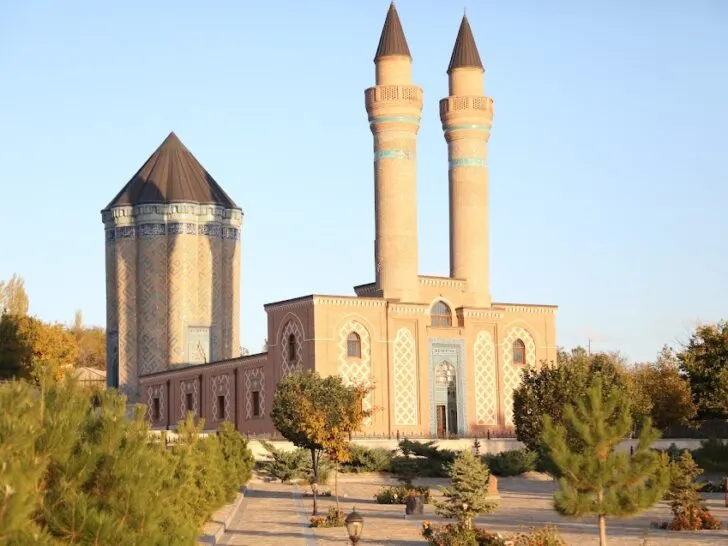
The city center holds several monuments worth serious time. The Momine Khatin Mausoleum is a 12th-century decagonal tower of exceptional geometric precision, built by the architect Ajami ibn Abubakr Nakhchivani, whose work represents the high point of medieval Azerbaijani architecture. The Khan’s Palace nearby was designed in Eastern architectural style and now houses an exhibition of Azerbaijani history adorned with richly ornamented stained-glass windows. Noah’s tomb, housed within a mausoleum complex that also provides views over the Heydar Mosque with its vibrant floral-patterned tilework, completes a city center circuit that takes roughly half a day at a comfortable pace. The Gulustan Mausoleum near the Iranian border is worth the detour specifically for the border perspective — standing there and looking across into Iran is a rare geopolitical experience that few travelers anywhere get to have.
The Food: Where Turkey, Persia, and the Silk Road Negotiated Terms
Nakhchivani cuisine is the direct product of its geography — shaped by the Silk Road, the Turkish border to the west, and the Persian influence from Iran to the south. Lamb dominates the meat dishes, and the kebab preparations here carry the unmistakable signature of Turkish charcoal grilling traditions rather than the milder Azerbaijani styles common in Baku. Shashlik and lula kebab are present on virtually every menu, but the regional dish that deserves particular attention is the lamb stew cooked in clay pots with potatoes and carrots — a preparation that produces a depth of flavor that comes from hours of slow cooking rather than technique sophistication.
The herbs used in Nakhchivani cooking — particularly dill, tarragon, and basil — carry the delicate aromatic character of the high mountain growing conditions, and fresh fruit and vegetables grown in the region’s fertile lowland areas appear in dishes and on tables as simply as bread does in France. Manti, a dumpling preparation similar to Turkish mantı and the Central Asian mantu, appears across multiple restaurants and reflects the Silk Road culinary crossroads this region occupies.
For dining, Kəndimiz (Our Village) Restaurant in Nakhchivan City serves traditional dishes in a setting designed around private group cabins — the local dining culture strongly favors communal eating in semi-private spaces rather than open restaurant floors. Nuh Yurdu Restaurant handles seafood from Turkey’s Black Sea region alongside Azerbaijani classics, which sounds incongruous for a landlocked mountain exclave but reflects the Turkish supply lines that feed much of the region’s commercial economy. Budget travelers eating at local cafes and bazaar food stalls can eat well for $8–12 per day. A mid-range restaurant meal for two runs $15–25 including drinks.
Getting There, Getting Around, and What It Costs
The most straightforward access is a domestic Azerbaijan Airlines flight from Baku Heydar Aliyev International Airport to Nakhchivan Airport, with flights running multiple times daily and taking approximately one hour. Flight prices from Baku hover around $40–80 USD one way depending on booking timing. International travelers can also enter overland from Turkey via the Sadarak border crossing or from Iran via Julfa, though visa requirements for both entry points should be confirmed well in advance of travel based on your nationality. There are no commercial flights from Europe or the USA directly to Nakhchivan, so Baku functions as the transit hub for all international arrivals.
Within Nakhchivan, there is no metro system and the bus network serves primarily city residents rather than tourist routes. The practical reality is that exploring the region requires either hired taxis negotiated on a day-rate basis or a rented car. Marshrutkas (shared minibuses) connect the city to Ordubad for around 2 AZN (roughly €1 / $1.10) each way, making that day trip accessible on any budget. For destinations like Alinja Castle, Batabat Lake, and the canyon roads, private taxi hire is the only realistic option. Budgeting approximately 150–200 AZN (€80–107 / $85–113) for transportation across a four-day stay is a reasonable estimate.
Climate and the Right Time to Go
Early summer — May through June — is the consensus best time to visit. The heat in July and August makes the Alinja Castle climb genuinely punishing, and the canyon roads reflect heat at levels that reduce the enjoyment of driving them. Autumn, particularly September and October, offers excellent light for photography and comfortable temperatures, with the northern mountain areas around Batabat turning through the full color range of the season. Winter is cold and some mountain roads become difficult, though the salt mine and city monuments are accessible year-round.
Accommodation and Budget
Nakhchivan City offers the widest accommodation range. Budget guesthouses and small hotels start around $24 per night, while mid-range options sit at $50–80 per night, and the upper end reaches $120–150 for the most comfortable hotels in the city. There are no international chain hotels here, which either concerns or excites you depending on your travel philosophy. Outside the capital, accommodation options thin out rapidly, and most travelers base themselves in Nakhchivan City and take day trips. A realistic daily budget for a solo traveler staying mid-range, eating well, and taking taxis runs approximately $70–100 per day.
Sample 4-Day Itinerary
A practical four-day structure: Day one covers Nakhchivan City thoroughly — Momine Khatin Mausoleum, Khan’s Palace, Heydar Mosque, Noah’s tomb, and an evening in the bazaar. Day two dedicates the full morning and early afternoon to Alinja Castle, with the Ashab-i Kehf cave added in the late afternoon. Day three heads north to Batabat Lake, returning via the Duzdag salt sanatorium and the Qarabaghlar mausoleum complex. Day four follows the southern border road through the red canyon landscape to Ordubad, ending at the Gulustan Mausoleum near the Iranian border before the return flight.
FAQ: What Travelers From Europe and the USA Actually Need to Know
Is Nakhchivan safe for Western travelers?
It is considered safe by most independent traveler assessments, with low levels of street crime and a culture that treats foreign visitors with genuine curiosity rather than hostility. As with all destinations bordering active geopolitical fault lines, checking your government’s current travel advisory before booking is standard practice rather than excessive caution.
Do I need a visa?
Citizens of most European countries and the USA require an Azerbaijani visa to enter the country, including Nakhchivan. The e-visa system through the official Azerbaijan e-visa portal is straightforward and processes in 3–5 days. If entering from Iran or Turkey, border crossing regulations require separate confirmation depending on nationality.
Is English spoken?
English proficiency is limited outside the hotel sector and younger educated residents of Nakhchivan City. Russian remains widely understood among older generations as a Soviet-era legacy. A translation app with offline Azerbaijani language packs downloaded before arrival will be genuinely useful rather than optional.
How does Nakhchivan compare to Tbilisi or Yerevan for off-the-beaten-path travelers?
Tbilisi has become a mainstream European city break destination and Yerevan draws a significant diaspora tourism market. Nakhchivan operates at a completely different level of visitor volume — you will encounter almost no other Western tourists, which is either the central appeal or the central deterrent depending on what you want from travel. The infrastructure is better than most travelers expect but the tourism ecosystem (English signage, tourist-oriented restaurants, walking tour networks) essentially does not exist here.
Can I combine Nakhchivan with a broader Azerbaijan trip?
Yes, and the domestic flight from Baku makes this easy. Sheki in northern Azerbaijan offers a sharply contrasting experience — wooden architecture, a silk history, and a more established tourist trail — and pairing it with Nakhchivan gives you a genuinely comprehensive picture of Azerbaijani cultural diversity. Baku itself is a separate experience entirely, a city that oscillates between oil-boom glass towers and a preserved medieval old town.
What are the currency and payment realities?
The Azerbaijani Manat (AZN) is the currency, trading at approximately 1 AZN to €0.53 / $0.57 as a working estimate. Card payments are accepted in hotels and larger restaurants in Nakhchivan City, but cash is essential for taxis, smaller cafes, market stalls, and all out-of-city transactions. ATMs exist in the capital.
Is the Alinja Castle climb suitable for non-hikers?
The ascent is steep but does not require hiking equipment or technical fitness — it is a strenuous walk rather than a hike. Anyone with reasonable mobility and forty-five minutes of patience can reach the top. The issues are heat in summer and the absence of shade on the exposed sections. Starting early in the morning mitigates both.
What about cultural etiquette?
Nakhchivan is predominantly Muslim and considerably more conservative than Baku. Modest dress is appropriate, particularly at religious sites like Ashab-i Kehf. Public displays of affection are rare in local culture. Photography of military installations, border areas, and some government buildings is restricted — when in doubt, ask before pointing a camera.
How long do most travelers spend here?
Three to four days covers the major sites thoroughly at a non-rushed pace. Two days is possible but leaves significant gaps. A week is viable for travelers who want to hike, explore minor sites, and absorb the region slowly rather than checklist it.
Is the Duzdag salt mine therapy worth it even for healthy travelers?
The therapeutic spa element is marketed primarily at visitors with asthma, bronchitis, and other respiratory conditions, but the underground environment is architecturally fascinating and the thirty-minute session is an experience that has no real equivalent in European travel. Think of it as a medically inspired cave visit rather than a conventional wellness treatment.
Where This Leaves the Honest Traveler
Nakhchivan will not suit everyone, and there is something almost clarifying about a destination that makes this obvious from the start. If your travel is organized around restaurant reservations, Instagram-verified viewpoints, and the social credibility of a well-known name, this exclave will feel like an absence of everything you came for. But if what you want is a place that carries genuine historical depth, landscapes that earn comparison to far more famous natural wonders, a food culture shaped by centuries of cross-border influence, and the particular texture of a region that has survived isolation, blockade, and geopolitical uncertainty without losing its sense of identity — Nakhchivan repays every effort you put into getting there. Europe has its own overlooked corners, and America has its forgotten interior towns, but very few places in the accessible world combine this density of historical layers with this level of genuine obscurity. The question is not whether Nakhchivan is worth visiting. The question is whether you are willing to arrive somewhere that has not prepared itself for you — and whether you are honest enough to admit that this is actually what travel was always supposed to feel like.

