


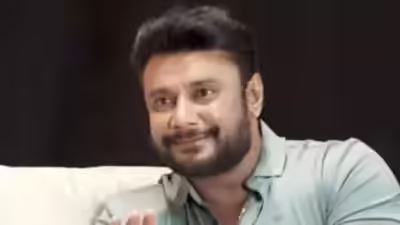
Darshan Thoogudeepa aka Challenging Star D-Boss is Sandalwood’s biggest name. Full biography, hit films, Renukaswamy case & untold life story inside.
Darshan Thoogudeepa
“D-Boss” • Challenging Star
Key Details
Born
16 Feb 1977
Known As
D-Boss
Current Status
As of April 2026
Darshan is currently in Bengaluru Central Prison in connection with the Renukaswamy Murder Case.
Arrested in June 2024 • Bail revoked by Supreme Court in Aug 2025 • Allowed family meetings in March 2026.
Career Highlights
Debuted as lead in Majestic (2002). One of the biggest and highest-paid stars in Kannada cinema with over 60 films.
Major Hits
Kariya, Saarathi, Krantiveera Sangolli Rayanna, Yajamana, Roberrt, Kaatera
Recent
The Devil (2025) – Released while he was in prison
Personal Background
Son of legendary actor Thoogudeepa Srinivas. His brother Dinakar runs Thoogudeepa Productions.
Passionate about wildlife and farming. Maintains a private mini-zoo in Mysuru.
Darshan Thoogudeepa is the defining superstar of Kannada cinema — a man whose career arc traces one of Indian entertainment’s most compelling stories of son-in-shadow-of-father rising to eclipse everything that came before him. Known universally as D-Boss and Challenging Star, he has delivered over 50 films across three decades, commanded a per-film fee of ₹20–25 crore, and built a production empire that reshaped Sandalwood’s commercial ambitions. Yet the same man who built this empire now sits at the centre of a criminal trial that has stunned Karnataka and forced an industry — and its fans — to confront the uncomfortable distance between a superstar’s screen image and the choices he makes when the cameras are off.
Early Life — The Boy Who Swept Film Sets
The Thoogudeepa name carries weight in Karnataka. His father, Thoogudeepa Srinivas, was a well-known Kannada actor famous for playing menacing villains — the kind of performer whose screen presence left an impression powerful enough to become a surname. Darshan grew up in Mysuru, received his early education there, and developed a fascination for cinema not through the comfort of a star household but through the raw mechanics of a working film set, where, as a child, he worked as a light boy and projectionist. This detail matters: while the industry would later call him a star kid, his entry into cinema was through labour, not lineage. His father was actively reluctant to support Darshan’s ambitions, which pushed the young Hemanth Kumar to enroll at Ninasam — the prestigious theatre training institute in Shimoga — against his father’s wishes, shortly before Thoogudeepa Srinivas passed away in 1995.
Training, Early Struggle, and the Debut Nobody Noticed
After Ninasam, Darshan spent years in the purgatory of television serials and tele-shows — the grinding, unglamorous holding pen where most aspiring actors quietly give up and go home. He did not. His film debut came in Mahabharatha (1997), where he was credited simply as Thoogudeepa Darshan and received no significant attention from audiences or critics. Three more films followed in 2000 and 2001 — Devara Maga, Vallarasu (Tamil), and Ellara Mane Dosenu — each passing without permanently altering his standing in an industry that had not yet figured out what to do with him. What kept him going through these years was not visible opportunity but an internal stubbornness that would later become his defining screen quality — the refusal to accept that the situation in front of him was the final situation.
The Breakthrough — Kariya and the Birth of D-Boss
Kariya (2003) changed everything. Directed by Rajendra Singh Babu and produced under the Rockline banner, the film gave Darshan his first commercially significant lead role and introduced audiences to the specific energy that would define his screen persona for the next two decades — physically imposing, emotionally direct, loyal to a fault, and explosive when provoked. Kalasipalya (2004) followed and cemented his mass-hero status. What Darshan had understood intuitively — and what his writers exploited expertly — was that the Kannada audience had a specific emotional appetite for a hero who felt like one of their own rather than a manufactured idol from a distant film family. The nickname D-Boss emerged organically from this dynamic, a fan-coined title that has since become more famous than his real name.
| Year | Film | Notes |
|---|---|---|
| 2003 | Kariya | Breakthrough film, established mass-hero identity |
| 2007 | Anatharu | Critical acclaim, performance-driven role |
| 2008 | Gaja | Major commercial success |
| 2010 | Porki | Remake of Telugu Pokiri, hit film |
| 2011 | Saarathi | Released during personal controversy, box office success |
| 2012 | Krantiveera Sangolli Rayanna | Karnataka State Film Award for Best Actor |
| 2019 | Yajamana | Pan-Karnataka blockbuster |
| 2021 | Roberrt | Big-budget actioner, strong fan reception |
| 2024 | Kaatera | ₹200 crore club, last major release before arrest |
Krantiveera Sangolli Rayanna — The Role That Defined His Legacy
If one film crystallises why Darshan is revered with a sincerity that transcends commerce, it is Krantiveera Sangolli Rayanna (2012), directed by Naganna. He played Sangolli Rayanna, the 19th-century freedom fighter who led an armed revolt against British rule in Karnataka — a figure of enormous regional pride and historical significance. Darshan’s performance earned him the Karnataka State Film Award for Best Actor and demonstrated, for those who still needed persuading, that beneath the mass-entertainer machinery there was a genuine actor capable of elevating historical material. The film remains one of the highest-grossing Kannada films of its era and is the clearest evidence that Darshan’s influence on Sandalwood is not merely commercial but cultural.
Kaatera — The Last Triumph Before the Storm
Released on December 29, 2023, Kaatera — directed by Tharun Sudhir and produced by Rockline Venkatesh — arrived as Darshan’s bid to stake his claim in a post-KGF Kannada cinema landscape that had permanently raised audience expectations. The film, set against the backdrop of the 1970s and rooted in caste conflict and land politics, collected ₹11 crore on its opening day, ₹50.68 crore in its first ten days, and ultimately crossed the ₹200 crore mark at the worldwide box office. It was a validation of everything Darshan had built — the fan network, the commercial instinct, the ability to anchor a large-scale period drama — and it arrived just months before his world collapsed.
Thoogudeepa Productions — The Empire Beyond Acting
In 2006, at the height of his commercial success, Darshan established Thoogudeepa Productions, making the strategic transition from actor to actor-producer — a move that gave him creative control, financial upside, and the ability to back projects that fit his vision of Kannada cinema. The banner’s first film was Jothe Jotheyali, in which Darshan appeared in a special role, and it ran for 150 days in theatres, validating the commercial instincts behind the venture. Beyond production, he expanded into film distribution, acquiring rights to films like Bulbul (2013) and shaping how Kannada cinema reached its audiences regionally. In June 2018, the Karnataka Forest Department appointed him as its Brand Ambassador — a recognition of his known passion for wildlife, given his ownership of a private mini-zoo near Tirumakudal Narsipur, outside Mysuru.
Personal Life — Family, Passion, and Privacy
Darshan married Vijayalakshmi, his relative, in 2003 at the Dharmasthala Temple. She was then a Chemical Engineering student — a pairing that had nothing cinematic about it and everything personal. The couple have a son, Vineesh. His brother Dinakar Thoogudeepa is a film director and screenwriter who runs Thoogudeepa Productions, keeping the family’s film legacy alive across departments. Beyond cinema, Darshan is known for his passion for cars, bikes, and animals — his private stud farm outside Mysuru houses a collection that reflects an outsized personality unbothered by the optics of modesty. His net worth is estimated between ₹80 crore and ₹100 crore, with income flowing from acting fees, production, distribution, real estate, and brand endorsements.
The Controversies — A Pattern That Preceded the Crisis
The 2024 murder case was not Darshan’s first collision with the law or public decency. In September 2011, his then-wife Vijayalakshmi filed a domestic violence complaint against him with the Bengaluru police. He was arrested, spent 14 days in judicial custody at Parappana Agrahara Jail, and only avoided a permanent fracture in his public image because industry veterans including Ambareesh and Jaggesh intervened to facilitate a settlement. He issued a public apology to his fans — and then, remarkably, his very next release Saarathi (2011) was a box office hit, demonstrating the extraordinary loyalty of a fanbase that absorbed the controversy and moved forward as though it had not occurred. There were also separate incidents involving allegations of assault on a waiter, which added to a portrait of a man whose off-screen temperament did not always match the disciplined loyalty of the heroes he played on screen.
The Renukaswamy Murder Case — The Point of No Return
On June 7, 2024, a 33-year-old fan named Renukaswamy — a medical store employee from Chitradurga — was abducted by an associate of Darshan named Raghu, held captive in a shed in Bengaluru, and beaten to death. The alleged motive was retribution for obscene messages Renukaswamy had sent on Instagram to Pavithra Gowda, an actress who had been in a relationship with Darshan for over a decade. According to police, Darshan himself allegedly beat the victim with a belt and administered electric shocks. The body was subsequently dumped in a storm water drain in an attempt to conceal the crime. On June 11, 2024, Darshan was arrested from a gym near a hotel in Mysuru. He was formally designated undertrial prisoner number 6106 at Parappana Agrahara Jail — the same prison where he had spent 14 days in 2011. A 3,991-page chargesheet was filed on September 3, 2024, charging Darshan, Pavithra Gowda, and 15 others with murder. In August 2025, the Supreme Court cancelled his bail, with Justices JB Pardiwala and R Mahadevan calling the High Court’s bail grant “mechanical” and “perverse,” warning it risked influencing witnesses. The trial formally began in December 2025, and as of April 2026, proceedings are ongoing with the court denying even home-cooked food for the accused in prison.
The Fan Question — Loyalty in the Face of Horror
Perhaps the most sociologically fascinating element of this case is the response of Darshan’s fanbase. A section of his followers continued to defend him publicly, with some even expressing sympathy for his actions — a phenomenon that exposes the dangerous depth of parasocial devotion that mass hero culture in South India can generate. The very nickname Makkal Selvan — People’s Treasure — becomes a bitterly ironic label when the “treasure” stands accused of murdering one of the very people who worshipped him. The case forced a wider cultural conversation in Karnataka about the impunity that superstardom creates, the structural silence of film industries around star misconduct, and the point at which fan loyalty transforms from affection into enablement.
The Positives — What He Built and Why It Matters
Setting aside the present legal reality, the arc of what Darshan built across three decades is genuinely impressive. He came from a working film family, refused to take a shortcut that was never really available to him anyway, trained at a theatre institution, served years of invisible labour on sets and in serials, and then constructed — through performance after performance — the most commercially consistent male star career in Kannada cinema’s modern era. He gave Sandalwood several of its biggest grossers, produced films that backed other talents, earned state recognition for historical performance, and built a brand identity so powerful that it survived a domestic violence arrest in 2011. Krantiveera Sangolli Rayanna alone is a contribution to Karnataka’s cultural self-representation that no controversy can wholly erase.
Where Things Stand — A Career Without Closure
As of April 2026, Darshan Thoogudeepa’s career is in complete suspension — not paused by age or changing tastes but by an active criminal trial for murder. The Devil: The Hero project he was filming at the time of his arrest remains unfinished. His production house is quiet. His public appearances are courtroom appearances. The man who once filled 150-day theatrical runs and built ₹200 crore box office numbers now occupies a prison cell in the same Parappana Agrahara facility he first entered in 2011, waiting for a verdict that will determine not just his freedom but the final chapter of a career that — in its first three decades — had everything required to be remembered only as a triumph. It is a story that Indian cinema has rarely told because it has rarely needed to: the superstar whose greatest antagonist turned out not to be a rival actor, a difficult director, or a box office misfire, but himself.

