
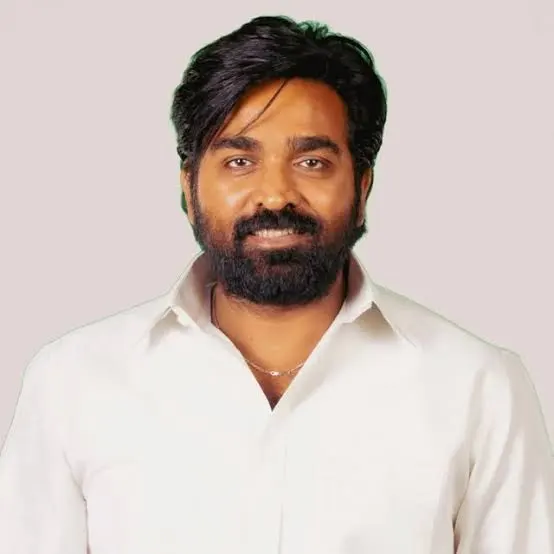
Vijay Sethupathi — Makkal Selvan, Biography, Movies & Net Worth | विजय सेतुपति कौन हैं? पूरी कहानी
Vijay Sethupathi
“Makkal Selvan” • People’s Son
Key Details
Born
16 January 1978
Spouse
Jessie (m. 2003)
Children
Surya & Shreeja
Known For
Versatile Roles
Career Highlights
Muthu Engira Kaattaan (2026)
Web Series • Premiered 27 March 2026
Received positive reviews. Success meet held on 9th April 2026.
Upcoming Projects
• Train (Mysskin)
• Arasan (Vetrimaaran)
• Slum Dog (Puri Jagannadh)
• Cameo in Jailer 2
Notable Films
Super Deluxe (2019)
96 (2018)
Vikram Vedha (2017)
Maharaja (2024)
Jawan (2023)
Biography & Achievements
Vijay Gurunatha Sethupathi, popularly known as Vijay Sethupathi or “Makkal Selvan”, is a highly acclaimed Indian actor and producer primarily working in Tamil cinema.
He rose to fame in 2012 with hits like Sundarapandian, Pizza, and Naduvula Konjam Pakkatha Kaanom. Known for his versatile and unconventional roles.
He has won the National Film Award, Filmfare Awards South, and Tamil Nadu State Film Awards. He also runs his own production house Vijay Sethupathi Productions.
Vijay Sethupathi (born January 16, 1978, Rajapalayam, Tamil Nadu) is one of the most singularly gifted actors in the history of Indian cinema — a man who worked as an accountant in Dubai, returned to Chennai with nothing but determination, spent years playing uncredited background roles, and eventually became the most bankable, most versatile, and most genuinely beloved actor in Tamil filmography. Nicknamed Makkal Selvan — meaning “People’s Treasure” — he did not inherit a throne, buy one, or force his way into one. He simply acted so honestly, so repeatedly, and so fearlessly across comedies, thrillers, tragedies, and villain roles that the industry ran out of ways to ignore him. With over 50 films to his name, a ₹140 crore net worth, and a career that has crossed four languages and reached global streaming platforms, Vijay Sethupathi is the definitive answer to anyone who believes Bollywood or Kollywood belongs only to those born inside it.
Early Life — The Accountant Who Became a Star
Vijay Sethupathi grew up in a modest Tamil family, completing his Bachelor of Commerce from Dhanraj Baid Jain College, Thoraipakam, Chennai — an academic background that has absolutely nothing to do with cinema and everything to do with the grounded financial pragmatism that defined his early career. Before acting paid a single stable rupee, he moved to Dubai and worked as an accountant — a choice born not of ambition but of necessity, the kind of practical detour that most eventual stars quietly erase from their biography. He returned to India with savings, a hunger, and a clarity about what he wanted to do, even if the industry had no idea yet who he was. His first years in Chennai’s film circuit involved playing background roles and minor supporting parts, invisible in scenes but relentlessly present on sets, studying the craft from the only vantage point available to him.
The Breakthrough Years — 2010 to 2013
His first lead role came in Seenu Ramasamy’s Thenmerku Paruvakaatru (2010), a film that won three National Awards and proved that Sethupathi could carry the emotional weight of a narrative without the crutch of commercial hero tropes. 2012 then became the year that rewrote his trajectory entirely: three films, three completely different roles — a villain in Sundarapandian, a thriller lead in Karthik Subbaraj’s Pizza, and a comedy anchor in Balaji Tharaneetharan’s Naduvula Konjam Pakkatha Kaanom — all released within the same calendar year, all critical and commercial successes. Soodhu Kavvum (2013) followed, a darkly comic crime film that is still considered one of Tamil cinema’s most intelligent screenplays, and within which Sethupathi delivered a performance of such relaxed, unpredictable brilliance that the question ceased to be whether he was talented and became instead how far that talent would actually travel.
Makkal Selvan — The Title He Earned
The nickname Makkal Selvan was not a marketing creation. It emerged organically during the production of Dharma Durai (2016), coined by the people on set and in the streets — a recognition that this was an actor who did not perform for critics, award committees, or industry validation, but seemed to act directly for the ordinary Tamil audience that saw its own reality reflected in every character he played. Unlike the heroic archetype of traditional Tamil cinema — the mass entertainer with six-pack, punch dialogues, and invincible swagger — Sethupathi consistently chose characters who looked and felt like the person sitting next to you on a bus. He gained weight, let his hairline recede naturally, wore unglamorous clothes, and brought a lived-in texture to every role that made his performances feel less like acting and more like documentation.
| Year | Film | Role | Significance |
|---|---|---|---|
| 2012 | Pizza | Lead | Karthik Subbaraj’s debut, breakthrough role |
| 2013 | Soodhu Kavvum | Das | Dark comedy classic |
| 2017 | Vikram Vedha | Vedha | Career-best villain, national recognition |
| 2018 | 96 | Ram | Most emotionally resonant performance |
| 2019 | Super Deluxe | Shilpa | Gender-fluid role, critically acclaimed |
| 2022 | Vikram | Cameo/Villain | Pan-India blockbuster ensemble |
| 2023 | Jawan | SRK’s Villain | Hindi cinema debut in A-list company |
| 2024 | Maharaja | Maharaja | Major commercial and critical success |
The Role That Moved a Nation — 96
If one film encapsulates the full emotional range of Vijay Sethupathi, it is C. Prem Kumar’s 96 (2018), where he played Ram — a photographer carrying thirty years of unexpressed love for a woman he never stopped loving and never fully pursued. The film contains almost no dramatic plot in the conventional sense. It is entirely built on silences, glances, and the specific sadness of a life half-lived, and Sethupathi inhabited it with a restraint so precise it made audiences weep in scenes where nothing conventionally heartbreaking was happening. 96 is now regularly cited as one of the finest Tamil films ever made, and Sethupathi’s performance in it is the reason most people say that.
Super Deluxe — The Boldest Choice
In Thiagarajan Kumararaja’s Super Deluxe (2019), Sethupathi played Shilpa — a transgender woman returning to a family that had moved on without her. The role required him to shatter virtually every convention of masculine Tamil screen heroism: appearance, voice, physicality, emotional register. He did it not with caricature or costume-drama bravado but with a tender, unhurried dignity that made Shilpa one of the most humane portrayals of a transgender person in Indian mainstream cinema. The film was a commercial underperformer but a critical landmark, and the performance permanently expanded the industry’s sense of what Sethupathi was willing to risk for a character.
Crossing Into Hindi Cinema
The Hindi film industry spent years watching what Tamil cinema already knew, and Vikram Vedha (2022) — the Hindi remake of the 2017 Tamil original — gave Bollywood its first proper, full-length encounter with Sethupathi in a lead antagonist role alongside Hrithik Roshan. His appearance in Shah Rukh Khan’s Jawan (2023) as the primary villain reached an entirely different scale — the film became one of the highest-grossing Hindi films in history, and Sethupathi’s performance was cited by critics as one of its few genuinely menacing elements. These appearances have not made him a Hindi film star in the conventional sense — he has not relocated his identity or filmography northward — but they have made him impossible to overlook on a national platform.
Net Worth, Assets and Lifestyle
Vijay Sethupathi’s net worth is estimated between ₹120 crore and ₹140 crore, built through acting fees, brand endorsements, and property investments. He charges approximately ₹15 crore per film and earns around ₹50 lakh through brand endorsements. He owns a luxurious bungalow in Chennai valued at ₹50 crore and has made significant real estate investments across Kilpauk, Ennore, and North Chennai collectively worth nearly ₹100 crore. His car collection — a BMW 7 Series, Mini Cooper, Toyota Fortuner, and Toyota Innova — reflects a personality that gravitates toward quality without ostentation. Despite this wealth, he is frequently photographed in plain shirts and slippers, an aesthetic consistency between the man off screen and the characters he chooses to play on it.
Family — The Anchor Behind the Stardom
Married since 2003 to Jessy, his relationship predates his fame by nearly a decade — a detail that matters because it grounds his public persona in a reality entirely removed from the star-system’s usual machinery of image management and strategic pairings. The couple has two children, Surya and Shreeja, and Sethupathi has spoken in multiple interviews about his family as the reason he remained emotionally sane during the years of rejection and invisibility before recognition arrived. He is also known to have produced films through his own production banner, backing small, unconventional stories that the mainstream industry would not otherwise fund — a form of giving back to the ecosystem that gave him his first chances.
Controversies and Criticism — The Honest Side
Sethupathi is not without his fault lines. The most publicly charged controversy came when he was cast as Ravana in Om Raut’s Adipurush (2023) — a mythological spectacle based on the Ramayana — and subsequently withdrew following intense public backlash from sections of the Hindu audience who found the casting of a Tamil actor in the role of the demon king culturally and religiously inappropriate. He handled the exit quietly, but the episode exposed the complicated politics of identity, religion, and casting that South Indian actors face when they cross regional boundaries in India’s deeply divided cultural landscape. A secondary criticism that surfaces regularly is the charge of overexposure — Sethupathi at peak popularity was releasing four to six films per year, and several critics noted that the sheer volume of his output inevitably diluted quality control, with some films serving as little more than paycheck projects that wasted his capability on underwritten material. There is also a persistent conversation about whether his reluctance to physically transform for roles — the weight, the unglamorous presentation — has occasionally cost him performances that required a different physical register, though his defenders argue that this very authenticity is the source of his power rather than its limitation.
What Makes Him Irreplaceable
The quality that separates Vijay Sethupathi from virtually every other actor working in Indian cinema today is his complete absence of self-consciousness in front of a camera. He does not appear to be performing — he appears to be existing inside a situation, and the camera simply happens to be there. This quality cannot be taught in acting schools or manufactured through workshop training; it is the product of a specific kind of lived experience, of someone who worked ordinary jobs and spent years invisible in crowd sequences, who came to acting not as a birthright but as a survival instinct. Every character he plays carries within it the sediment of that history — the accountant in Dubai, the background actor on Chennai sets, the man who said yes to every role because there was no guarantee another one was coming. That sediment is what audiences sense without being able to name it, and it is why, twenty-six years after his first uncredited appearance and sixteen years after his first lead role, Vijay Sethupathi remains not just popular but genuinely, stubbornly, irreplaceably necessary to Indian cinema.
