
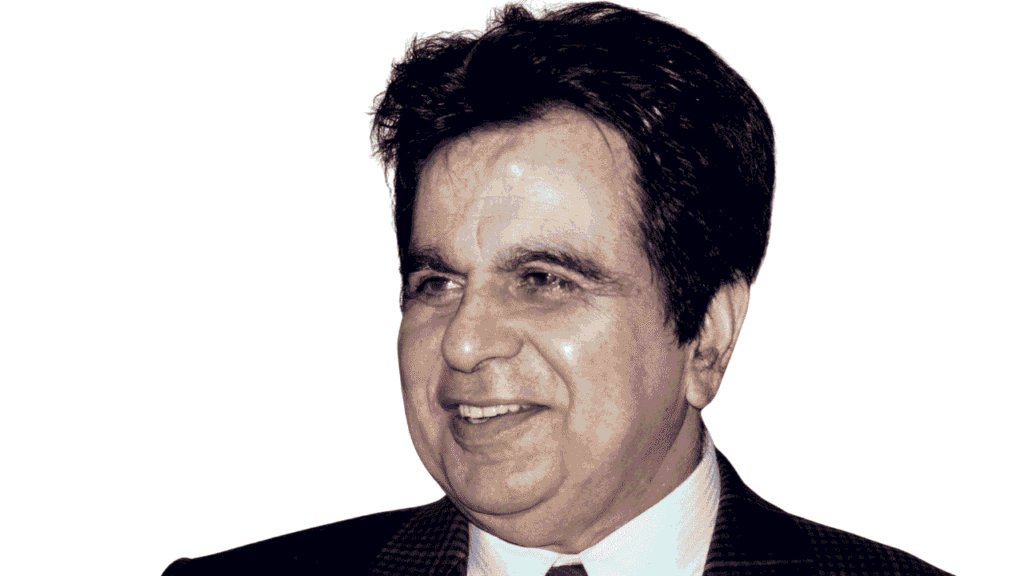
Dilip Kumar complete biography — from Peshawar to Bollywood immortality. Full life story, Mughal-e-Azam, Devdas, Ganga Jamuna, 8 Filmfare awards, Dadasaheb Phalke Award, Padma Vibhushan, and the complete legacy of Indian cinema’s greatest actor.
Introduction
Dilip Kumar was not merely a great actor. He was the actor against whom every Hindi film actor who came after him has been measured, consciously or unconsciously, for more than seven decades. Born Muhammad Yusuf Khan on December 11, 1922, in Qissa Khwani Bazaar, Peshawar — in what is today Pakistan — he grew up as one of twelve children in a family of modest means that survived through fruit trading and agricultural work. He had no training in performance. He had no connection to the Bombay film industry. He had no plan that pointed toward cinema. But Devika Rani, the legendary actress and owner of Bombay Talkies, spotted him in 1943, gave him a screen name, and offered him his first film role — and what followed was not just a career but the complete redefinition of what acting in Indian cinema could look like. He brought naturalism, interiority, and emotional truth to Hindi films at a time when theatrical exaggeration was the industry standard. He did this before Marlon Brando formalized method acting in Hollywood. Critics and scholars have noted that he independently pioneered psychological realism in performance in the mid-1940s, making him not just India’s greatest actor but one of the great acting innovators in world cinema history. He won the Filmfare Award for Best Actor eight times — a record he shares with Shah Rukh Khan. He received the Dadasaheb Phalke Award, India’s highest film honour, in 1994. He received the Padma Bhushan in 1991 and the Padma Vibhushan in 2015. The Government of Pakistan honoured him with the Nishan-e-Imtiaz in 1998 — the only Indian actor ever to receive Pakistan’s highest civilian award. He was appointed Sheriff of Bombay from 1979 to 1982, served as a Member of Parliament from 2000 to 2006, and remained a living institution of Indian culture until his death on July 7, 2021, at the age of 98. He was, in the truest sense of every word, the First Superstar of Indian cinema.
Who Was Dilip Kumar?
Dilip Kumar — born Muhammad Yusuf Khan — was an Indian actor, film producer, writer, and public figure who dominated Hindi cinema from the late 1940s through the 1960s and remained a monumental cultural presence for the rest of his life. He was called the Tragedy King because of his supreme command over deeply emotional, suffering characters across his peak years. But he was also capable of extraordinary comic timing and physical energy, as his double role in Ram Aur Shyam (1967) proved. His six-decade career covered over sixty films, and he worked with India’s greatest directors — Mehboob Khan, Bimal Roy, Guru Dutt, K. Asif, Raj Kapoor, Yash Chopra, Ramesh Sippy, and Subhash Ghai. He was married to actress Saira Banu from 1966 until his death — a love story that itself became one of Hindi cinema’s most cherished real-life narratives.
| Detail | Info |
|---|---|
| Real Name | Muhammad Yusuf Khan |
| Screen Name | Dilip Kumar (given by Devika Rani) |
| Date of Birth | December 11, 1922 |
| Birthplace | Qissa Khwani Bazaar, Peshawar, British India |
| Date of Death | July 7, 2021 (aged 98) |
| Spouse | Saira Banu (married 1966) |
| Active Career | 1944 — 1998 |
| Filmfare Best Actor Awards | 8 (record shared with Shah Rukh Khan) |
Early Life — Peshawar to Bombay
Muhammad Yusuf Khan grew up in Peshawar’s Qissa Khwani Bazaar — the famous Street of Storytellers — in a large family that relied on fruit trade and farming for income. His father Ghulam Sarwar Khan owned orchards in Peshawar and Deolali, and the family moved between both locations through Dilip’s childhood. After Partition in 1947, the family formally relocated to Bombay, but Dilip was already in the city before that — circumstances had brought him there earlier, when a disagreement with his father led him to leave home and find work independently. He worked at a canteen in Pune for a British establishment and earned enough to sustain himself before a chance encounter with Devika Rani and Dr. Masani in 1943 led to his Bombay Talkies screen test. Devika Rani recognized immediately that the young man in front of her had something that no amount of training could manufacture — a natural emotional authenticity that the camera would find irresistible. She gave him his screen name Dilip Kumar, signed him to Bombay Talkies, and set him on the path that would change Indian cinema permanently.
The Zero to Hero Journey
Dilip Kumar’s zero was genuinely zero — no film family, no Bombay connections, no training, no plan. His first film Jwar Bhata (1944) was not a success. But Bombay Talkies gave him subsequent opportunities, and he learned on the job with a speed and depth that nobody around him anticipated. Jugnu (1947) opposite the legendary Noor Jehan was his first commercial success, and Nadiya Ke Par the same year became the highest-grossing Indian film of 1947. Then came Andaz (1949) — Mehboob Khan’s sophisticated love triangle opposite Raj Kapoor and Nargis — which became the highest-grossing Indian film ever at the time of its release. So within five years of his debut, the man who arrived in Bombay with nothing had become the most commercially powerful actor in the industry. But commercial power was never the point for Dilip Kumar. The point was always the craft. And so he kept making choices that challenged him rather than choices that protected his position — playing tortured, doomed characters when the industry wanted him to play heroes, producing films that he believed in rather than films that were safe, and treating every role as a problem worth solving at the deepest possible level of human understanding.
The Tragedy King Era — Devdas and Emotional Mastery
The films that earned Dilip Kumar the title of Tragedy King are among the most emotionally overwhelming performances in the history of world cinema. Deedar (1951) and Daag (1952) established his supreme command over grief and longing. But Devdas (1955), directed by Bimal Roy, is the performance that defines this entire era of his career. He played Devdas — the self-destructive, alcohol-consumed Bengali zamindar’s son unable to reconcile his love with his social obligations — with a depth of psychological disintegration that has never been matched by any subsequent actor who has attempted the same role. He won the Filmfare Award for Best Actor for Devdas and followed it immediately with Azaad (1955) — a comic swashbuckler — proving that the Tragedy King could also deliver pure entertainment with equal mastery. Naya Daur (1957), directed by B. R. Chopra, won him another Filmfare Award for Best Actor and showed his commitment to social subjects, playing a tonga driver fighting mechanised transport in a story about economic displacement. The emotional range across just these four films — grief, intoxication, comedy, social anger — covers more psychological territory than most actors explore across an entire career.
Mughal-e-Azam — The Defining Monument
Mughal-e-Azam (1960), directed by K. Asif, is not just a film. It is a monument of Indian civilization — the most expensive Hindi film ever made at the time of its production, the result of nearly a decade of filming, and the highest-grossing Bollywood film of its era. Dilip Kumar played Prince Salim — the Mughal heir who defies Emperor Akbar’s authority for his love of the court dancer Anarkali — with a regal gravity and passionate vulnerability that the scale of the production demanded and that he alone among his contemporaries could have delivered. The film’s climactic scenes between Dilip Kumar and Prithviraj Kapoor — playing father and son, emperor and rebel — are among the greatest acted confrontations in Indian cinema’s history. Mughal-e-Azam broke every previous box office record in Bollywood and held its records for years. When the film was colorized and re-released in 2004, it became a commercial hit all over again — fifty years after its original production began — proving that some performances transcend every limitation of time, technology, and changing taste.
Ganga Jamuna — The Actor as Producer
Ganga Jamuna (1961) is significant not only as one of Dilip Kumar’s greatest performances but as the first film he produced himself, through his own production banner. He wrote the story and played Ganga — a dacoit driven to outlawry by injustice — opposite his own real-life brother Nasir Khan, who played Jamuna, the policeman pursuing him. The decision to produce his own film gave him complete creative control over every aspect of the production — the casting, the script, the dialect choices, the music. And the result was a film that the Bengal Film Journalists’ Association named best film of 1962, and one that influenced every dacoit film and every film about brothers-on-opposite-sides-of-the-law that Hindi cinema produced in the following three decades. Sholay, Deewaar, and dozens of other landmark films carry the DNA of Ganga Jamuna in their storytelling structure. So Dilip Kumar’s contribution to Hindi cinema was not just as a performer but as a creative architect whose choices shaped the genres and conventions of the industry long after he made them.
The Five Year Break and Comeback
In 1976, at a point when he was still commercially viable and critically respected, Dilip Kumar made one of the most unexpected decisions of his career — he stopped. He took a five-year break from films, stepping completely away from the industry at a time when most actors would have continued pursuing every opportunity available. He has spoken in interviews about creative exhaustion and the need to recenter himself. So the break was not a crisis but a conscious choice — the kind of professional self-awareness that very few actors of any era have possessed. He returned in 1981 with Kranti, directed by Manoj Kumar, and the industry welcomed him back with enormous commercial success. Shakti (1982), directed by Ramesh Sippy, paired him with Amitabh Bachchan — the actor who had effectively replaced him as Hindi cinema’s dominant star during the 1970s — in a generational conflict story that became one of the most discussed films of that year. His work in Shakti earned him his eighth and final Filmfare Award for Best Actor, closing out a record that remains unmatched in terms of consecutive decades of recognized excellence.
The Later Career — Karma, Saudagar, and Qila
The 1980s and early 1990s brought Dilip Kumar into a new phase of his career — playing commanding, authoritative older characters that used his natural gravitas and his decades of accumulated screen presence as creative resources rather than fighting against them. Vidhaata (1982) and Karma (1986), both directed by Subhash Ghai, were massive commercial entertainers that introduced him to a new generation of audiences who had not grown up watching Devdas and Mughal-e-Azam but responded instantly to the authority and intelligence he brought to every scene. Saudagar (1991), also directed by Subhash Ghai and co-starring Raaj Kumar, was one of that year’s biggest hits and gave him one of his most layered performances of the decade. Mashaal (1984), directed by Yash Chopra, earned him a Filmfare nomination. His final film was Qila (1998), where he played a double role — Judge Amarnath Singh and Jagannath Singh. So his last film, like his greatest films, returned to the double role format he had mastered in Ram Aur Shyam three decades earlier, a perfect structural closing of the circle.
Complete Filmography
Dilip Kumar’s complete filmography spans from 1944 to 1998 — fifty-four years — and covers over sixty lead roles plus several guest appearances. His debut was Jwar Bhata (1944). His first major success was Jugnu (1947). His breakthrough was Andaz (1949). His key films through the 1950s include Babul (1950), Hulchul (1951), Deedar (1951), Sangdil (1952), Daag (1952), Shikast (1953), Amar (1954), Azaad (1955), Devdas (1955), Uran Khatola (1955), Naya Daur (1957), Musafir (1957), Yahudi (1958), Madhumati (1958), and Paigham (1959). His 1960s films include Mughal-e-Azam (1960), Kohinoor (1960), Ganga Jumna (1961), Leader (1964), Dil Diya Dard Liya (1966), Ram Aur Shyam (1967), Aadmi (1968), and Sagina Mahato (1970). His 1980s return phase includes Kranti (1981), Shakti (1982), Vidhaata (1982), Mazdoor (1983), Mashaal (1984), Duniya (1984), Dharm Adhikari (1986), Karma (1986), and Saudagar (1991). His final films were Kalinga (1996), Qila (1998), and a special appearance in Nikaah (1982).
Awards and Honours — A Record That Stands Alone
Dilip Kumar’s awards record is the most comprehensive and sustained recognition of artistic achievement in the history of Indian cinema. He won the Filmfare Award for Best Actor eight times — for Daag (1954), Azaad (1956), Devdas (1957), Naya Daur (1958), Kohinoor (1961), Leader (1965), Ram Aur Shyam (1968), and Shakti (1983) — a record spanning nearly three decades that he shares only with Shah Rukh Khan, who required twenty years to match it. He was the first actor ever to win the Filmfare Best Actor Award, receiving it for Daag in 1954. He received the Silver Hugo Award at the Chicago International Film Festival in 1961 for Gunga Jumna. The Government of India honoured him with the Padma Bhushan in 1991 and the Padma Vibhushan in 2015 — India’s third and second-highest civilian honours respectively. He received the Dadasaheb Phalke Award — India’s highest film recognition — in 1994. The Government of Pakistan honoured him with the Nishan-e-Imtiaz in 1998, making him the only Indian actor ever to receive Pakistan’s highest civilian award — a political and cultural honour of extraordinary significance given the history between the two nations. He also received the National Film Award Lifetime Achievement Award in 2008 from then-President Pratibha Patil.
Saira Banu — The Love Story That Lasted a Lifetime
Dilip Kumar married actress Saira Banu on October 11, 1966 — he was forty-four, she was twenty-two, and the age gap of twenty-two years did not prevent what became one of Hindi cinema’s most genuinely devoted and publicly loving marriages. Saira Banu was herself one of the most celebrated actresses of her era, known for Junglee, Shagird, Purab Aur Paschim, and Victoria No. 203. But after her marriage to Dilip Kumar, she gradually withdrew from films to focus on their life together — a choice she has consistently described in interviews as completely her own and completely without regret. She was his constant companion, caregiver, and public voice through his later decades, speaking on his behalf during his various health challenges with a love and devotion that moved everyone who observed it. When Dilip Kumar passed away on July 7, 2021, Saira Banu’s grief was one of the most publicly visible expressions of personal loss in the history of Indian entertainment. Their fifty-five-year marriage was, by every measure, one of the great love stories that Hindi cinema produced — not on screen but in life.
Political Career and Public Service
Beyond cinema, Dilip Kumar served Indian public life in two significant capacities. He was appointed Sheriff of Bombay by the Governor of Maharashtra from 1979 to 1982 — an honorary but symbolically important civic role that reflected the enormous public trust and cultural authority he commanded. He was elected to the Rajya Sabha — India’s upper house of Parliament — in 2000 and served as a Member of Parliament until 2006, representing the Indian National Congress. His parliamentary term gave him a platform to speak on cultural policy, film industry concerns, and national issues at the highest governmental level. He used that platform thoughtfully rather than performatively, and his colleagues across party lines respected his contributions. So Dilip Kumar’s public life was as multidimensional as his artistic life — he was not merely a film star who collected honours but a genuine public figure who contributed to Indian civic and cultural life across six consecutive decades.
Legacy — Why Dilip Kumar Cannot Be Replaced
Dilip Kumar’s legacy is not a matter of critical opinion or historical nostalgia. It is a structural fact of Indian cinema. Because he pioneered psychological realism in Hindi film performance in the 1940s — independently, before Marlon Brando and the American Method Acting movement had become globally influential — he created the template that every subsequent generation of Hindi film actors has either followed or reacted against. Amitabh Bachchan, Shah Rukh Khan, Aamir Khan, Naseeruddin Shah, Om Puri — every major male Hindi film actor of the last sixty years has acknowledged Dilip Kumar as the foundational reference point for what serious screen acting in Indian cinema means. Satyajit Ray called him “the finest actor India has produced.” Raj Kapoor, his greatest contemporary rival for the title of Hindi cinema’s dominant star, said “Dilip Kumar is the complete actor.” When he passed away on July 7, 2021, Prime Minister Narendra Modi called his death “a colossal loss to our cultural world.” The Indian film industry observed a day of mourning. And across social media, fans and film professionals from every country where Hindi cinema reaches shared their grief — because Dilip Kumar was not just India’s actor. He was proof of what acting could be.
Frequently Asked Questions
When was Dilip Kumar born and when did he die?
Dilip Kumar was born on December 11, 1922, in Peshawar, British India. He passed away on July 7, 2021, in Mumbai, India, at the age of 98.
What was Dilip Kumar’s real name?
His real name was Muhammad Yusuf Khan. The screen name Dilip Kumar was given to him by Devika Rani, the legendary actress and owner of Bombay Talkies, when she signed him in 1943.
How many Filmfare Awards did Dilip Kumar win?
He won the Filmfare Award for Best Actor eight times — a record spanning from 1954 to 1983 — which he shares with Shah Rukh Khan. He was also the first actor ever to receive the Filmfare Best Actor Award, for Daag in 1954.
What is Dilip Kumar’s most famous film?
Mughal-e-Azam (1960), directed by K. Asif, is his most iconic film and one of the greatest Hindi films ever made. He also considers Devdas (1955) and Ganga Jamuna (1961) among his most significant personal achievements.
Why was Dilip Kumar called the Tragedy King?
He earned the title because of his extraordinary command over deeply emotional, suffering characters across his peak years in the 1950s — particularly in films like Deedar, Daag, Devdas, and Andaz, where his psychological depth in portraying grief and longing was unmatched by any contemporary.
Who was Dilip Kumar’s wife?
He married actress Saira Banu on October 11, 1966. Their fifty-five-year marriage lasted until his death in 2021 and is considered one of the most devoted real-life love stories in Hindi cinema’s history.
What national awards did Dilip Kumar receive?
He received the Padma Bhushan in 1991, the Dadasaheb Phalke Award in 1994, the National Film Award Lifetime Achievement Award in 2008, and the Padma Vibhushan in 2015 — along with the Nishan-e-Imtiaz from the Government of Pakistan in 1998.
Did Dilip Kumar serve in politics?
Yes. He was appointed Sheriff of Bombay from 1979 to 1982 and served as a Member of Parliament in the Rajya Sabha from 2000 to 2006, representing the Indian National Congress.
What was Dilip Kumar’s last film?
His last film was Qila (1998), directed by Umesh Mehra, in which he played a double role as Judge Amarnath Singh and Jagannath Singh.
Why is Dilip Kumar considered a pioneer of method acting?
He independently developed a naturalistic, psychologically immersive approach to screen acting in the mid-1940s — before Marlon Brando and the American Method Acting movement had become globally influential. His approach influenced every generation of serious Hindi film actors that followed him.
How many films did Dilip Kumar appear in?
He appeared in over sixty films as a lead across his fifty-four-year career, plus several guest and cameo appearances. He was famously selective about his roles — so the relatively modest total count reflects deliberate creative choices rather than a shortage of opportunities.
What happened when Dilip Kumar took a break from films?
He voluntarily stepped away from films for five years from 1976 to 1981, citing creative exhaustion. He returned with Kranti (1981) to enormous commercial success, and subsequently won his eighth Filmfare Award for Best Actor for Shakti (1982).
